

What you can do with this tool
- Measure anything in both systems: turn centimetres into inches for a US tape measure or pattern.
- Check a screen size: see what a TV or laptop measured in cm means in inches.
- Follow a craft or DIY plan: convert the measurements to the ruler you actually own.
- Shop for the right fit: match cm sizes to inches when a store lists only one.
It takes seconds — and the rest of this guide shows you the exact maths behind the switch.
Use the free CM to Inches Converter: type any centimetre value for the exact inches instantly — open the converter →
📌 Key takeaways
- The formula: inches = centimetres ÷ 2.54 — exact, by international agreement.
- 10 cm is 3.94 inches — that's why 10 cm is “about 4 inches”.
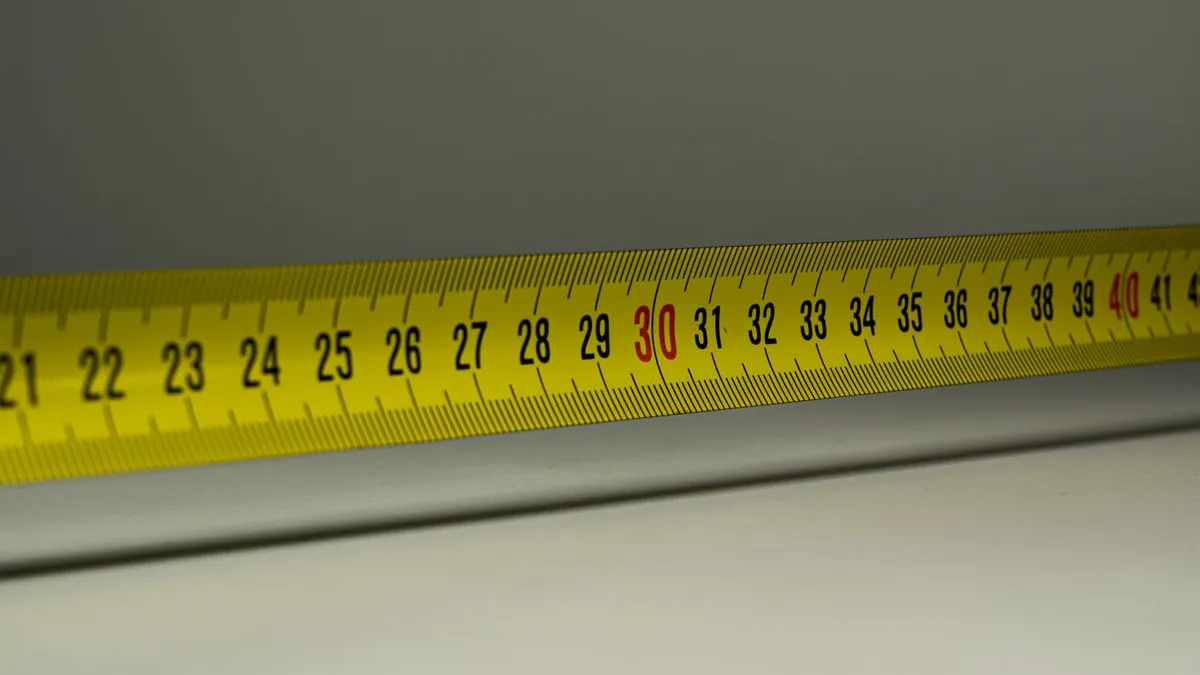
- A standard 30 cm ruler is 11.81 inches — just shy of a foot.
- TV sizes: 32″ = 81.28 cm, 55″ = 139.7 cm, 65″ = 165.1 cm.
📏 Cm to Inches — at a glance
The key numbers from this guide, in one place.
1Centimeters and inches: what you're actually converting
Two rulers, two worlds. The centimeter is metric — one hundredth of a meter, the system used by nearly every country on Earth, by all of science, and by every tape measure sold outside the US. The inch is imperial — one twelfth of a foot, still the everyday unit in the United States for height, screens, paper, and a thousand hardware-store items.
Here's the size relationship to lock in first: an inch is about two and a half times bigger than a centimeter. Hold your thumb and forefinger about an inch apart — that's roughly 2.5 cm. A centimeter is closer to the width of your pinky fingernail. Once your hands know the rough sizes, the numbers stop feeling abstract.
Why do these two systems keep colliding? Because the modern world runs on both at once. Your phone's screen is sold in inches but its case lists millimeters. IKEA designs in centimeters and sells in America. Sewing patterns cross borders. Recipes, luggage, TV sizes, human height — the cm/inch border runs straight through daily life, and crossing it is a skill, not a trivia fact.
The good news: unlike currencies or shoe sizes, this conversion is exact and eternal. It never fluctuates, never rounds, never depends on the brand. One fixed number connects the two systems, and it's been the same since 1959.
2The 2.54 cm to inches formula (and why it's exact)
Here it is — the entire conversion, both directions:
One inch is exactly 2.54 centimeters. Not approximately — exactly, by international agreement. In 1959, the US, UK, Canada, Australia, New Zealand and South Africa signed the International Yard and Pound Agreement, which defined the inch as precisely 2.54 cm. Before that, the American inch and the British inch differed by a couple of millionths of a meter — irrelevant for a bookshelf, but a real problem for precision engineering. The agreement ended the disagreement forever, and every cm-to-inch conversion since has used this one number.
Because 1 inch = 2.54 cm exactly, the reverse is exact too: 1 cm = 1 \u00f7 2.54 = 0.39370078\u2026 inches, usually rounded to 0.3937. Our converter uses the full-precision value internally, so what you get is the mathematically exact answer, not an approximation.

3Mental math: converting in your head
You won't always have a converter handy — in a store aisle, at a market abroad, mid-conversation. Three shortcuts cover nearly every real situation.
The 2.5 shortcut (cm \u2192 inches). Divide by 2.5 instead of 2.54 — close enough for shopping and small talk. 20 cm \u00f7 2.5 = 8 inches (exact: 7.87). 30 cm \u00f7 2.5 = 12 inches (exact: 11.81). The error is about 1.6%, invisible in everyday life.
The 0.4 shortcut (cm \u2192 inches). Multiply by 0.4. 25 cm \u00d7 0.4 = 10 inches (exact: 9.84). 15 cm \u00d7 0.4 = 6 inches (exact: 5.91). Same 1.6% error, sometimes easier to do in your head than dividing.
The 2.5 shortcut reversed (inches \u2192 cm). Multiply by 2.5 instead of 2.54. A 55-inch TV \u00d7 2.5 = 137.5 cm (exact: 139.7). A 6-foot person: 72 inches \u00d7 2.5 = 180 cm (exact: 182.9).
One more anchor worth memorizing: 30 cm \u2248 1 foot (exact: 11.81 inches). And 2.5 cm \u2248 1 inch. With those two, you can estimate almost anything: a 90 cm doorway is about 3 feet; a 13 cm phone is about 5 inches.
4A short history of the inch and the centimetre
The inch is old enough that nobody knows exactly where it started. The Old English word ynce came from the Latin uncia, a twelfth part, and for centuries an inch was loosely the width of a thumb. English kings kept redefining it — one famous rule said three barleycorns laid end to end made an inch.
The centimetre is far younger and far tidier. It arrived with the metric system in 1790s France: the metre was defined from the size of the Earth, and the centimetre was simply one hundredth of it. No thumbs, no barleycorns, just division by ten.
The two met in 1959. The international yard and pound agreement fixed the inch at exactly 2.54 centimetres — not approximately, exactly. That is why converting between cm and inches today is a clean division, with no rounding in the factor itself.
5Worked examples: height, screens, rulers
Let's convert the things people actually convert.
Human height. Say you're 175 cm and an American form asks for feet and inches. First convert to total inches: 175 \u00f7 2.54 = 68.9 inches. Divide by 12: 68.9 \u00f7 12 = 5.74 feet — that's 5 full feet plus 0.74 \u00d7 12 = 8.9 inches. So 175 cm \u2248 5 ft 9 in. Reverse check: 5 ft 9 in = (5 \u00d7 12) + 9 = 69 inches \u00d7 2.54 = 175.26 cm. Matches.
TV and monitor screens. Screen sizes are sold diagonally in inches worldwide — even in metric countries. A 55-inch TV: 55 \u00d7 2.54 = 139.7 cm of diagonal. A 32-inch monitor: 32 \u00d7 2.54 = 81.28 cm. This matters when you're measuring whether it fits the wall unit you bought in centimeters.
| Centimeters | Inches (exact) | You'll meet it as |
|---|---|---|
| 10 cm | 3.94 in | Phone width, small photo print |
| 15 cm | 5.91 in | Smartphone height |
| 20 cm | 7.87 in | Tablet short edge |
| 25 cm | 9.84 in | Dinner plate diameter |
| 30 cm | 11.81 in | School ruler, pizza (medium) |
| 40 cm | 15.75 in | Carry-on depth limit |
| 50 cm | 19.69 in | Suitcase height (cabin) |
| 100 cm | 39.37 in | One meter — just over a yard |
| Height (ft/in) | Centimeters | Height (ft/in) | Centimeters |
|---|---|---|---|
| 5'0" | 152.40 cm | 5'8" | 172.72 cm |
| 5'2" | 157.48 cm | 5'10" | 177.80 cm |
| 5'4" | 162.56 cm | 6'0" | 182.88 cm |
| 5'6" | 167.64 cm | 6'2" | 187.96 cm |
6Where it actually matters: shopping, DIY, sewing, travel
Online shopping. This is the #1 real-world use. A US store lists a jacket's sleeve as 25 inches; your body measurements are in centimeters. 25 \u00d7 2.54 = 63.5 cm. A European shoe site lists insoles in cm; the American size chart wants inches. Getting this wrong means paying return shipping — getting it right takes ten seconds.
DIY and furniture. IKEA designs in metric, American homes are built in feet and inches. That bookshelf is 202 cm tall: 202 \u00f7 2.54 = 79.5 inches — and now you know whether it clears your 80-inch ceiling nook (it does, barely). Measure twice, convert once, buy once.
Sewing and crafts. Patterns cross borders constantly — a US pattern in inches, fabric sold by the centimeter. A pattern piece marked 18 inches needs 18 \u00d7 2.54 = 45.72 cm of fabric width. Here the exact 2.54 matters: rounding to 2.5 across a whole garment can shift seams by a centimeter or more.
Travel and luggage. Airlines publish size limits both ways, but not always consistently — always check the centimeters, since metric is the legally binding version on most international carriers. A 55 \u00d7 40 \u00d7 20 cm cabin bag is 21.65 \u00d7 15.75 \u00d7 7.87 inches.
Paper and printing is the quiet one nobody thinks about until it goes wrong. US Letter (8.5 \u00d7 11 in) is 21.59 \u00d7 27.94 cm; international A4 is 21 \u00d7 29.7 cm. Close — but not the same, which is why a US-formatted document printed on A4 (or vice versa) comes out with odd margins or a clipped footer. If you ever design something for both markets, build it in the target size from the start rather than converting after.
7Going the other way: inches to centimeters
The reverse trip is just as common — arguably more so, since screens, paper sizes and American products all arrive in inches and need translating into the metric world most of us measure in.
The formula: centimeters = inches \u00d7 2.54. A 65-inch TV: 65 \u00d7 2.54 = 165.1 cm diagonal. US Letter paper (8.5 \u00d7 11 inches): 8.5 \u00d7 2.54 = 21.59 cm wide, 11 \u00d7 2.54 = 27.94 cm tall — which is why it never quite matches A4 (21 \u00d7 29.7 cm), a quiet annoyance for anyone who's printed a US document abroad.
Fractional inches deserve a note, because American hardware lives in fractions: 1/2", 3/4", 5/8". Convert the fraction to a decimal first, then multiply. A 3/4-inch pipe: 0.75 \u00d7 2.54 = 1.905 cm (19.05 mm). A 5/8-inch wrench: 0.625 \u00d7 2.54 = 1.5875 cm. Our converter accepts decimals directly, so 0.75 in \u2192 1.905 cm with no fraction juggling.
8Mistakes that cost people money (and fabric)
Multiplying when you should divide. The classic. Converting 100 cm to inches by multiplying: 100 \u00d7 2.54 = 254 "inches" — a number that should immediately smell wrong, since inches are the bigger unit and the inch number must be smaller. Sanity check every answer: cm \u2192 in makes the number smaller (divide); in \u2192 cm makes it bigger (multiply).
Rounding too early. Using 2.5 across a multi-step project — say, converting a room's dimensions to order flooring — compounds the error. 400 cm at 2.5 gives 160 inches; at 2.54 it's 157.48. That's a 2.5-inch gap, enough to leave you short on material. Estimate with 2.5, buy with 2.54.
Mixing up the decimal. 0.3937 inches per cm, not 3.937. It's an easy slip when typing fast, and it makes your answer 10\u00d7 wrong — the kind of error that ruins a 3D print or a machine part. If your converted number looks wildly off, check the decimal point first.
Forgetting height needs two steps. 175 cm isn't "17.5 inches" and it isn't "1.75 feet." Height in the imperial world is feet and inches: convert to total inches first (68.9), then split into feet and remainder (5 ft 9 in). Skipping the split is how forms get filled in wrong.
9Our free converter: the 3-second version
Rules are great; instant answers are better. Our converter does the 2.54 math at full precision the moment you type — and the swap button flips the direction without retyping.
Type any value — whole numbers, decimals like 0.75, even heights — and you get the exact conversion plus a quick-reference table. It runs entirely in your browser: no account, no tracking, nothing uploaded.
Convert cm \u2194 inches instantly — free
Exact 2.54 math, instant results, a 1–50 cm reference table and FAQs. No signup, private by Qevryn.
\U0001f4cf Open the CM to Inches Converter100% free \u00b7 No account \u00b7 Private by Qevryn
10Frequently asked questions
How many inches is 1 cm?
1 centimeter equals 0.3937 inches. To convert any centimeter value to inches, divide by 2.54 — for example, 10 cm \u00f7 2.54 = 3.937 inches.
Why is 1 inch exactly 2.54 cm?
In 1959, the International Yard and Pound Agreement standardized the inch as exactly 2.54 centimeters, ending decades of slightly different national definitions in the US, UK and other countries. It's exact by treaty, not by measurement.
How do I convert cm to inches without a calculator?
For a quick estimate, divide the centimeters by 2.5 (or multiply by 0.4). Example: 20 cm \u00f7 2.5 \u2248 8 inches (exact: 7.87 in). Use the exact 2.54 for anything you cut, build or buy.
What is 5 feet 9 inches in cm?
5 feet 9 inches equals 175.26 cm. Convert the feet to inches first (5 \u00d7 12 = 60, plus 9 = 69 inches), then multiply by 2.54.
Is a centimeter bigger than an inch?
No. One inch is about 2.54 times bigger than one centimeter. 1 cm = 0.3937 inches, and 1 inch = 2.54 cm — so the inch number is always the smaller one.
How do I convert inches back to centimeters?
Multiply the inch value by 2.54. For example, 10 inches \u00d7 2.54 = 25.4 cm. Use the swap button on our converter to flip the direction instantly.
Keep exploring
Length is just one corner of the toolbox. These related tools pair naturally with the guide above:
iLoveUnit is a Qevryn product — free, private, no signup.
Related guides
More step-by-step guides on this topic: