
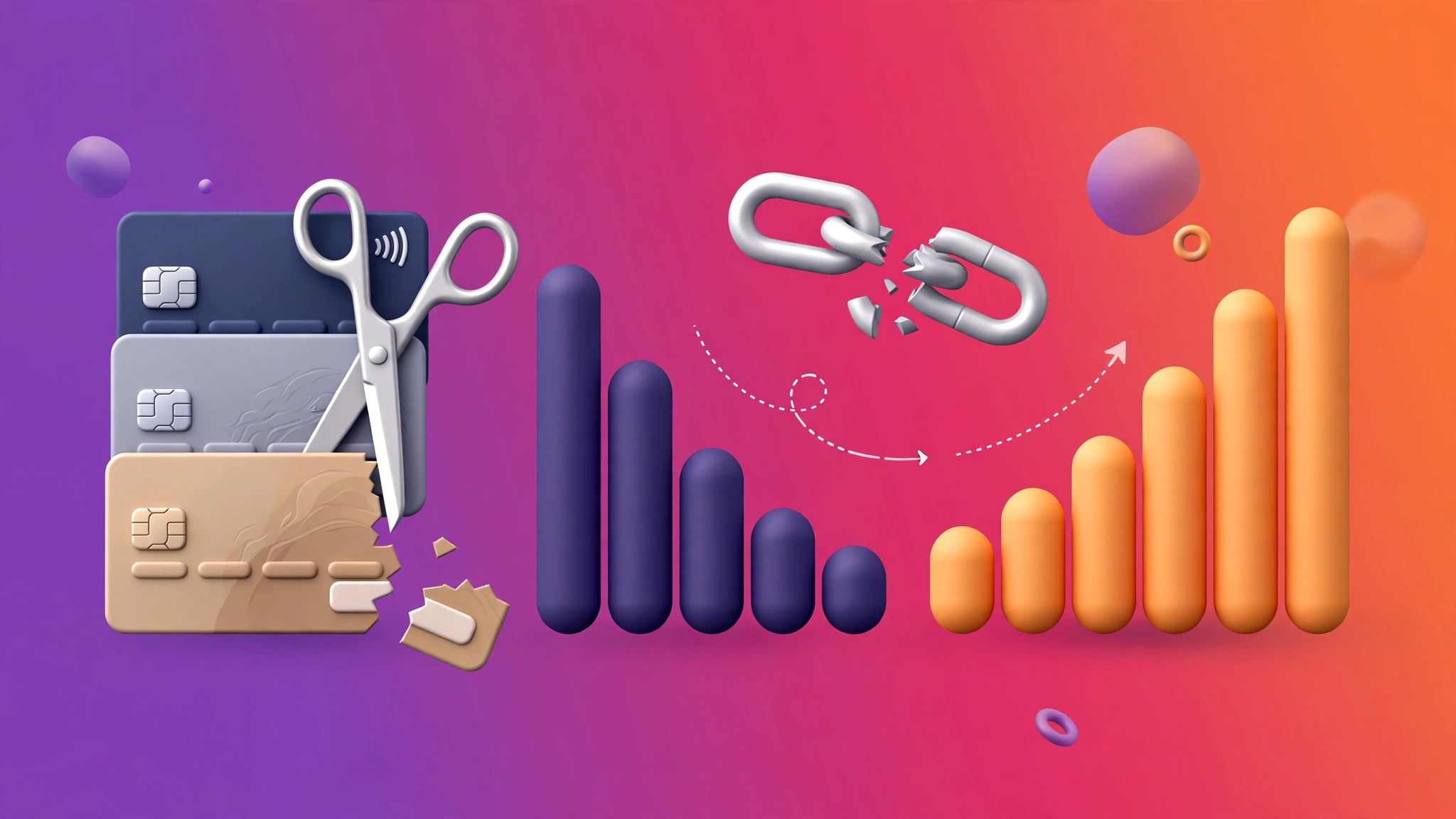
What you can do with this tool
- See your real debt-free date: compare minimum payments with a proper payoff plan.
- Pick snowball or avalanche: test both and choose the one you'll actually stick to.
- Find out how much interest you save: see the difference a plan makes in real money.
- Stay motivated with a clear finish line: watch the months shrink as your payment rises.
It takes seconds — and the rest of this guide shows you how to pick the plan that gets you debt-free fastest.
Use the free Debt Payoff Calculator: compare the snowball and avalanche plans and see your debt-free date — open the calculator →
📌 Key takeaways
- Minimums only: 82 months and $4,480 of interest.
- Snowball plan: 20 months and $1,159 of interest — same debts, same income, a plan instead of minimums.
- Monthly interest = balance × (APR ÷ 12): pay more than the interest and the balance finally falls.
- Snowball or avalanche both work: snowball wins on motivation, avalanche wins on maths — pick the one you will stick to.
💰 Debt Payoff — at a glance
The key numbers from this guide, in one place.
1The minimum-payment trap (with real numbers)
Credit card statements list a "minimum payment" that feels helpful \u2014 pay this much and you stay in good standing. What they don't emphasize is what minimum payments do: stretch a balance across most of a decade while you pay back double.
Here's the trap with real amortization math. You owe $5,000 at 24% APR and pay $125 a month \u2014 a plausible minimum on that balance. Month one, the interest charge alone is $5,000 \u00d7 24% \u00f7 12 = $100. Of your $125 payment, $100 evaporates into interest and only $25 touches the actual debt. At that pace it takes 82 months \u2014 nearly 7 years \u2014 and you pay $5,159 in interest on a $5,000 debt. Total paid: $10,159. You bought $5,000 of stuff and paid for it twice.
This isn't an accident of arithmetic \u2014 it's the business model. Minimums are typically set around 1\u20132% of the balance plus interest, calibrated to keep you paying (and profitable) as long as possible. The statement is legally required to show you the alternative: look for the box that says "if you pay only the minimum" \u2014 the years and total cost printed there are the trap, quantified.
2The formula — the snowball plan, step by step
The debt snowball works on focus: you pay the minimum on every debt, then throw every spare rupee or dollar at the smallest balance first. When it is gone, its payment rolls into the next smallest. The payoff time for any single debt comes from the same formula as a card payoff:
Run it debt by debt, smallest first, and add each freed-up payment to the next one. That rollover is where the snowball gets its speed.
Months = −ln(1 − 500 × 0.01667 ÷ 200) ÷ ln(1.01667) = 2.6 months — about 3 months. Total paid = 3 × 200 = $600, so interest = $100. That $200 a month is now free to attack the next debt.
The mistake is spreading extra money evenly across all your debts. A little extra everywhere feels fair, but it clears nothing. One focused payoff frees a whole payment, and that freed payment is what makes the next debt fall faster.
3How APR becomes the interest you actually pay
APR \u2014 Annual Percentage Rate \u2014 is the yearly price of borrowing, expressed as a percentage. But interest isn't charged yearly; it's charged monthly (usually daily, then summed monthly \u2014 close enough to monthly for planning). The conversion:
So 24% APR means roughly 2% per month on whatever you still owe. $5,000 \u00d7 2% = $100/month (our trap example). 18% APR is 1.5%/month. A 7% car loan is about 0.58%/month. The APR number looks abstract; the monthly bite is concrete \u2014 always translate it.
And here's the part that makes debt grow while you sleep: interest compounds on the remaining balance. Each month's interest is computed on what's still owed \u2014 which includes last month's unpaid interest if your payment didn't cover it. Pay less than the monthly interest and the balance rises even though you're paying. That's called negative amortization, and it's how people "pay every month" while the balance barely moves.

4A short history of getting out of debt
Debt payoff plans are older than credit cards. In the 19th century, "debt snowball" thinking showed up in household advice books: pay the smallest debt first, feel the win, and keep going. The idea was psychological long before it had a name — a cleared debt, however small, proves the plan works.
The method got its modern name in the 1990s and 2000s, when personal-finance writers and radio hosts started teaching it to households buried in card debt. The best-known champion, Dave Ramsey, made the snowball the centrepiece of his "baby steps" plan, arguing that behaviour beats maths: people stick with a plan that gives them quick wins, even if paying the highest-rate debt first (the "avalanche") saves slightly more interest on paper.
The argument between snowball and avalanche is still going. Research has mostly sided with the snowball on one point: people who clear a small debt first are more likely to keep going. The interest saved by the avalanche is real, but only if you actually finish — and finishing is the hard part.
5Snowball vs avalanche: the honest comparison
When you have multiple debts and some extra money each month, which debt gets the extra? Two famous strategies answer differently:
The avalanche: pay minimums on everything, throw all extra cash at the highest APR first. Mathematically optimal \u2014 it kills the most expensive debt fastest and minimizes total interest.
The snowball: pay minimums on everything, throw all extra cash at the smallest balance first. Psychologically powerful \u2014 you eliminate an entire debt quickly, and that win fuels the next one.
Let's settle it with real numbers. Two debts, $250/month extra beyond minimums:
- Store card: $4,000 at 24% APR, $100 minimum
- Personal loan: $2,000 at 10% APR, $60 minimum
| Strategy | Payoff order | Debt-free in | Total interest |
|---|---|---|---|
| Minimums only | \u2014 | 82 months (6.8 yrs) | $4,480 |
| Snowball (smallest first) | Personal loan \u2192 Store card | 20 months | $1,159 |
| Avalanche (highest APR first) | Store card \u2192 Personal loan | 18 months | $808 |
The avalanche wins on math: 2 months faster and $351 less interest than the snowball here. But look at the bigger picture \u2014 either strategy crushes minimums-only: roughly 5 years sooner and $3,300\u2013$3,700 less interest. The gap between the two strategies ($351) is a tenth the gap between having a strategy and not having one ($3,672).
6The power of extra payments
Extra payments are the closest thing to a cheat code in personal finance. Every extra dollar goes entirely to principal \u2014 and principal you kill today never accrues interest tomorrow, or next month, or next year. The savings compound in your favor for the entire remaining life of the debt.
Watch what happens on a $10,000 balance at 20% APR ($200 minimum) as the extra payment grows:
| Extra per month | Debt-free in | Total interest | Interest saved vs minimums |
|---|---|---|---|
| $0 (minimums) | 109 months (9.1 yrs) | $11,680 | \u2014 |
| $50 | 67 months (5.6 yrs) | $6,617 | $5,063 |
| $100 | 50 months (4.2 yrs) | $4,718 | $6,962 |
| $200 | 33 months (2.8 yrs) | $3,044 | $8,636 |
Read that first row again: $50 extra a month saves $5,063 and 3.5 years. That's a 100-to-1 return on the extra payment \u2014 not because $50 is magic, but because it strikes at the compounding working against you and turns it around. Doubling the payment ($200 extra) doesn't just halve the time \u2014 it wipes out nearly three-quarters of the interest.
Where does "extra" come from? The usual suspects: the subscription audit (cancel three $15/month services = $45), the snowball freed-up minimum (each killed debt's minimum joins the extra pile \u2014 that's literally why it's called a snowball), windfalls (tax refund, bonus) thrown as lump sums. Even irregular extras help \u2014 an extra $500 once a year on the example above still shaves off thousands.
7Building your payoff plan, step by step
Theory is nice; here's the actual playbook. It takes about 30 minutes with our calculator open.
Step 1 \u2014 list every debt. Name, balance, APR, minimum payment. All of them: cards, personal loans, store financing, the "0% for 12 months" deal that's about to detonate. Debts you don't list don't get paid \u2014 they just accrue.
Step 2 \u2014 find your extra. Income minus essentials minus minimums = your extra payment. Be honest but not heroic: a plan demanding $800/month that collapses in March is worse than a $300 plan you sustain for two years. Start with what you can definitely do.
Step 3 \u2014 pick snowball or avalanche. Enter your debts in our calculator, try both orders, and look at the two numbers that matter: months to freedom and total interest. If the gap is small, pick the one that motivates you. If it's big, pick avalanche and let the savings motivate you.
Step 4 \u2014 automate it. Set the minimums to autopay (never miss, never pay late fees) and the extra as an automatic transfer on payday. Automation beats willpower \u2014 every study of saving behavior says so, and debt payoff is saving in reverse.
Step 5 \u2014 review quarterly. Balances drop, APRs change (that 0% promo ends!), income shifts. Fifteen minutes every three months keeps the plan honest. And celebrate each killed debt \u2014 then roll its old minimum into the extra pile. That's the snowball growing.
8The psychology: why the math isn't the hard part
Here's an uncomfortable truth from behavioral research: the mathematically best plan you quit is worse than the good-enough plan you finish. Debt payoff is 20% arithmetic and 80% behavior, and the behavior has known failure modes.
The "I'll start when\u2026" delay. When things calm down, after the holidays, next month. Meanwhile interest compounds daily \u2014 on our $10,000/20% example, every month of delay costs about $167 in interest alone. Starting imperfectly today beats starting perfectly in March.
Lifestyle creep during payoff. Three months of discipline, then "I've earned it" spending that adds new charges. The rule that actually works: no new debt while paying off old debt. Not "less." None. New charges at 24% while you're killing old charges at 24% is running on a treadmill.
The invisible progress problem. Early on, balances barely move (remember month 2 of the trap: $250 paid, $50 of progress). This is where most people quit \u2014 right before the curve bends. The fix is tracking the interest per month, not just the balance: watching it fall from $100 to $80 to $60 is visible proof the plan is working, months before the balance looks impressive.
This is also the honest case for the snowball: killing a whole debt in 4 months gives your brain the win it needs to keep going for 20. If you know you're motivated by progress you can see, that's not weakness \u2014 it's self-knowledge. Use it.
9Mistakes that keep people in debt
Only paying minimums. The trap from section 1. If you remember nothing else: minimums are the most expensive way to repay that exists.
Ignoring the highest APR. Every month, the highest-APR balance generates the most interest per dollar. Extra money sent to a 10% loan while a 24% card sits there is like bailing the shallow end while the deep end floods. (Unless you're deliberately snowballing \u2014 then it's a conscious trade, not an oversight.)
Raiding retirement to pay cards. Cashing out a 401k to kill 24% debt feels logical, but you pay income tax plus usually a 10% penalty \u2014 and you destroy decades of compounding. The math rarely works; the behavior (no emergency fund, so the cards refill) almost never does.
Closing old cards immediately. Once a card is paid off, closing it can ding your credit score (shorter history, higher utilization ratio). Keep it open, use it for one small recurring charge, autopay in full. The available credit actually helps your score \u2014 as long as the balance stays zero.
No emergency fund. Paying every spare dollar to debt with zero savings means the next car repair goes right back on the card \u2014 at 24%. Most advisors suggest keeping a small buffer ($500\u2013$1,000) while paying down debt, then building it properly after. The buffer isn't lost progress; it's what protects the progress.

10Our free calculator: your debts, your timeline
Enter up to 4 debts \u2014 name, balance, APR and minimum payment each \u2014 plus your monthly extra payment. The calculator runs both the snowball and avalanche strategies side by side: payoff order, months to debt-free, total interest, and interest saved versus minimums-only.
Change the extra payment and watch the timeline move in real time \u2014 it's the fastest way to feel what section 4 proved with tables. Everything runs in your browser: no account, your debts never leave your device.
Map your route out of debt \u2014 free
Up to 4 debts, snowball vs avalanche compared, extra-payment scenarios, interest saved. No signup, private by Qevryn.
\U0001f4b3 Open the Debt Payoff Calculator100% free \u00b7 No account \u00b7 Private by Qevryn
Watch: debts shrink away — the snowball picks up speed as balances fall.
11Frequently asked questions
What is the debt snowball method?
Pay minimums on all debts and throw every extra dollar at the smallest balance first. When it's gone, its old minimum joins the extra payment aimed at the next-smallest \u2014 the payment "snowballs." It's optimized for motivation: quick wins keep you going.
What is the debt avalanche method?
Pay minimums on all debts and throw every extra dollar at the highest APR first. It's mathematically optimal \u2014 it minimizes total interest and usually the timeline too, since the most expensive debt dies fastest.
Which is better: snowball or avalanche?
Avalanche always wins on math \u2014 in our worked example, 18 months and $808 interest vs 20 months and $1,159 for snowball. But both crush minimums-only (82 months, $4,480). Pick avalanche if the APR gap is large; pick snowball if quick wins keep you motivated. The best strategy is the one you actually follow.
How does APR become monthly interest?
Divide by 12: monthly interest \u2248 balance \u00d7 (APR \u00f7 12). At 24% APR that's about 2% of the balance every month \u2014 $100/month on $5,000. If your payment doesn't cover the monthly interest, the balance grows even while you pay (negative amortization).
How much do extra payments really save?
Enormously. On $10,000 at 20% APR ($200 minimum), adding just $50/month saves $5,063 in interest and 3.5 years; $200 extra saves $8,636 and cuts 9.1 years to 2.8. Every extra dollar goes straight to principal and kills all the future interest it would have earned.
Should I keep an emergency fund while paying off debt?
Yes \u2014 a small one ($500\u2013$1,000). Without it, the next surprise expense lands right back on the card at 24%, undoing months of progress. Think of the buffer as protecting your payoff plan, not competing with it.
Keep exploring
Debt math is just one corner of the toolbox. These related tools pair naturally with the guide above:
iLoveUnit is a Qevryn product — free, private, no signup.
Related guides
More step-by-step guides on this topic: