
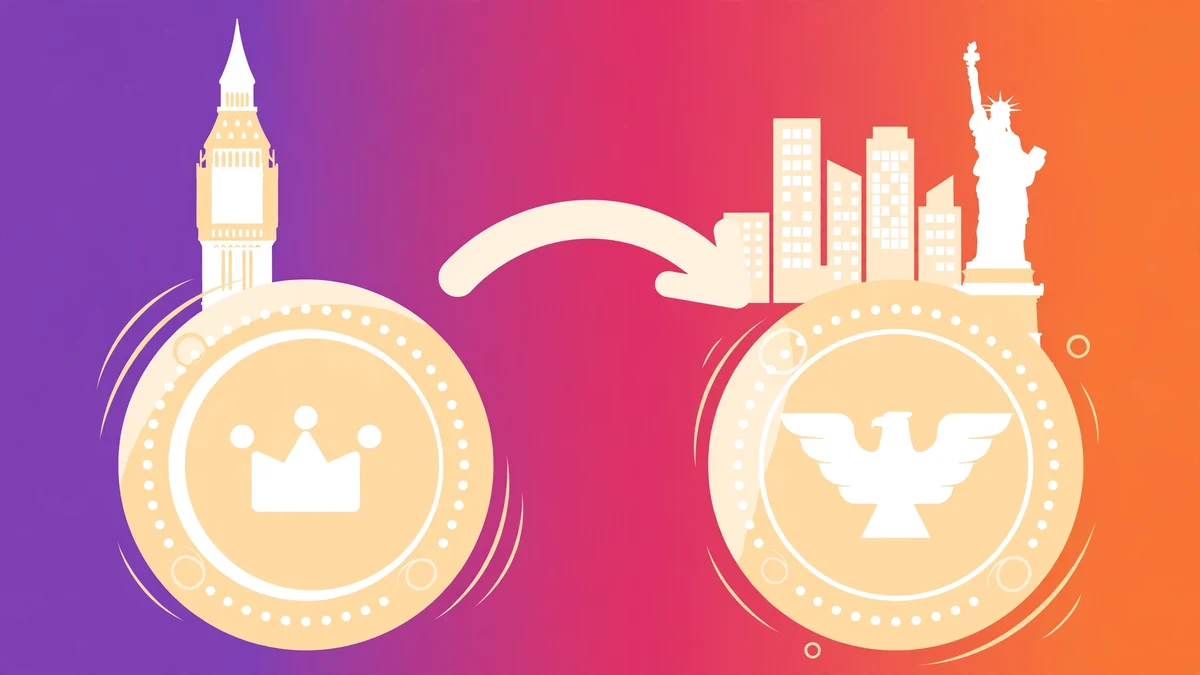
What you can do with this tool
- Check what your pounds buy in dollars: a trip, a purchase, or a payment, before you commit.
- Read “cable” the right way: see why 1.27 means one pound buys 1.27 dollars.
- Compare offers: use the market rate to tell if a deal is fair or overpriced.
- Work out your real income: turn a dollar salary or a pound payment into the currency you live in.
It takes seconds — and the rest of this guide shows you how to use it well.
Use the free GBP to USD Converter: type any pound amount and get the exact dollars instantly at the live rate — open the converter →
📌 Key takeaways
- The quote: GBP/USD means the pound is the base: a rate of 1.27 means one pound buys 1.27 dollars.
- The pound is worth more: One pound has been worth more than one dollar for decades, usually between $1.20 and $1.35 in recent years.
- Cable has lived through it all: From the $4.86 gold-standard pound to $1.05 in 1985 and above $2 in 2007.
- The 3% test: The market rate is your benchmark — if an offer is 3% away from it, you are overpaying.
💱 GBP to USD — at a glance
The key numbers from this guide, in one place.
1What is the GBP to USD pair?
GBP/USD is the exchange rate between the British pound and the US dollar — how many dollars one pound buys. It is one of the most traded pairs in the world, and the oldest: traders call it "cable" because its price was first sent across the Atlantic by telegraph cable in the mid-1800s.
The pair is quoted as GBP/USD, so the pound is the base: a rate of 1.27 means one pound buys 1.27 dollars. If the number rises, the pound is strengthening; if it falls, the dollar is strengthening. The pound has been worth more than the dollar for decades, usually sitting between $1.20 and $1.35 in recent years.
Both currencies float freely, so the pair moves constantly — on interest rates, economic data, politics, and the mood of global markets.
2The formula — multiply by the rate
Pounds to dollars is a single multiplication:
One pound buys more than one dollar, so the answer is always larger than the amount you started with. If your result comes out smaller, you divided by accident.
400 × 1.27 = $508.
150 × 1.27 = $190.50. Back the other way: $190.50 ÷ 1.27 = £150.
The mistake that costs people money is using the USD to GBP rate (below 1, about 0.79 in this example) as if it were the GBP to USD rate. £400 × 0.79 = $316 — nearly $200 short. Before you multiply, check the rate is above 1 for pounds to dollars.
3Who uses this conversion?
Travellers. Britons visiting New York and Americans visiting London live on this rate. A few cents' move changes a holiday budget by hundreds of dollars or pounds.
Businesses. The UK and the US are two of the world's biggest trading partners. Every shipment, service contract and invoice between them runs through this rate.
Investors. British stocks, American bonds, and global funds all translate through cable. A rising dollar shrinks the dollar value of British investments, and vice versa.
Freelancers and remote workers. Britons paid in dollars and Americans paid in pounds convert regularly, and the rate decides their real income.
4How to use the GBP to USD converter
Simple and live:
- Enter the amount in pounds — what you have or what you need.
- Read the dollar result instantly. The converter fetches the live rate.
- Flip it to see how many pounds a dollar amount buys.
- Check again before a big transaction. Cable moves during the day, and a large payment deserves a fresh rate.
For small amounts, any live rate is fine. For large ones — a property deposit, a business payment — compare two or three providers, because the rate and the fee together decide the cost.
5What moves GBP to USD?
- Interest rates: the Bank of England vs the Fed. The biggest driver. When the Fed raises rates and the Bank of England does not, dollars become more attractive and cable falls. When the Bank raises and the Fed holds, cable rises.
- UK politics. The pound is one of the most politically sensitive major currencies. Elections, budgets and big policy announcements move it fast — the pound's sharp falls around major votes are famous in market history.
- Economic data. Jobs, inflation and growth figures from either side shift expectations about future rates, and the pair moves on the expectation.
- Risk appetite. In nervous times, money flows into the dollar as a safe haven, pushing cable down. In calm times, it flows back and the pound recovers.
No one predicts cable reliably day to day. Use the live rate you can see, not a forecast someone guessed.
6Mistakes people make with GBP to USD
- Using a stale rate. A rate from yesterday is already history. For anything bigger than pocket money, check live.
- Ignoring the spread. Banks and cards add a margin to the market rate, plus sometimes a fee. The market rate is your benchmark — if an offer is 3% away from it, you are overpaying.
- Changing money at the airport. The worst rates in town, every time. Use a card or change money before you travel.
- Accepting dynamic currency conversion. When a card terminal abroad offers to charge you in your home currency, decline it — the rate is almost always worse than letting your bank convert.
7A short history of cable
Cable has lived through more history than any other currency pair. In the 1800s, the pound was the world's reserve currency and the dollar was the upstart; the rate was fixed under the gold standard, and a pound bought about $4.86 for decades. The telegraph cable that gave the pair its name carried the price between London and New York in minutes — revolutionary speed for the time.
The twentieth century broke the fix. The pound was devalued in 1949 and again in 1967, and in 1971 the Bretton Woods system collapsed, letting currencies float freely. Cable floated with it, and the swings began: the pound fell to about $1.05 in 1985, its lowest ever, then climbed above $2 in 2007, its highest in decades, before the financial crisis knocked it back down.
The last decade has been just as dramatic. The Brexit vote in 2016 sent the pound down sharply overnight, and it has spent most of the years since between $1.20 and $1.35 — well below the $1.50–$1.70 range it occupied before the vote. Each political shock leaves a fingerprint on the chart, and cable's history reads like a diary of British politics.
Through all of it, cable has remained one of the most traded pairs on Earth, because the UK and the US are two of the world's biggest economies and their trade never stops. The rate today is the product of 150 years of economics and politics — and tomorrow it will move again, on a rate decision, a jobs report, or an election. That is why no one prints a fixed cable rate, and why the live converter on this page is the only number worth trusting.
8Tips for travellers and businesses
Travellers: get a card with no foreign-transaction fee and let the bank convert at the market rate. Carry a little cash for small vendors, and never accept the terminal's offer to convert for you.
Businesses: if you have regular pound or dollar payments, ask your bank about a forward contract — it locks today's rate for a future payment, removing the guesswork from your margins.
Freelancers: hold a multi-currency account and convert when the rate is favourable rather than on payday. Over a year, timing the conversion adds up.
Everyone: check the rate on the day you transact. A 1% move on a £10,000 payment is £100 — worth thirty seconds of checking.
Convert GBP to USD at the live rate — try the free converter
Enter your pounds and see the dollars instantly at the live market rate — no sign-up, no stale tables, no guessing.
💷 Open the GBP to USD Converter100% free · No account · Private by Qevryn
| Period | What happened to cable |
|---|---|
| 1800s | The pound was the world's reserve currency; the rate was fixed near $4.86 under the gold standard |
| 1949 and 1967 | The pound was devalued |
| 1971 | The Bretton Woods system collapsed and currencies floated freely |
| 1985 | The pound fell to about $1.05, its lowest ever |
| 2007 | The pound climbed above $2, its highest in decades |
| 2016 | The Brexit vote sent the pound down sharply overnight |
| Since 2016 | Mostly between $1.20 and $1.35 — well below the $1.50–$1.70 range before the vote |
9Frequently asked questions
How many USD is 1 GBP?
The rate changes constantly, so there is no fixed answer — check the live converter on this page. The pound has been worth more than the dollar for decades, usually between $1.20 and $1.35 in recent years.
Why is GBP to USD called cable?
Because the rate was first sent across the Atlantic by telegraph cable in the mid-1800s. The nickname stuck, and traders still call the pair cable today.
Why does GBP to USD change every day?
Both currencies float freely, so the rate moves with interest-rate expectations, economic data, UK politics and global risk appetite. It is one of the most traded pairs in the world.
What makes the pound go up against the dollar?
Usually higher UK interest rates (or expectations of them), strong British economic data, or calm global markets that pull money out of the safe-haven dollar. The reverse pushes cable down.
Do I get the same rate the converter shows?
Not exactly. The converter shows the live market rate; banks, cards and transfer services add a margin and sometimes a fee. The market rate is your benchmark for judging whether an offer is fair.
Should I accept dynamic currency conversion abroad?
No — when a card terminal offers to charge you in your home currency, the rate is almost always worse than letting your bank convert. Always choose to pay in the local currency.
iLoveUnit is a Qevryn product — free, private, no signup.
Keep exploring
One pair is rarely enough. These converters cover the rest: