

What you can do with this tool
- Convert kilograms to pounds: 70 kg is 154.32 lb, so a gym or doctor's figure makes sense in either unit.
- Check your luggage before you fly: a 23 kg checked bag is 50.7 lb, and that is where the factor really matters.
- Read stone weights in kg: 13 st 7 lb is 85.73 kg, so a UK scale reading translates at once.
- Work out ounces and pounds: 16 ounces make a pound and 14 pounds make a stone, so the old family of units stops being a puzzle.
It takes seconds — and the rest of this guide shows you how to use it well.
Use the free Weight Converter: convert kilograms, pounds, ounces and stone instantly — open the converter →
📌 Key takeaways
- The formula: pounds = kilograms × 2.20462.
- 70 kg is 154.32 lb: 13 st 7 lb is 85.73 kg.
- A 23 kg checked bag is 50.7 lb: luggage limits are where the factor matters.
- The imperial family is gloriously irregular: 16 ounces make a pound, 14 pounds make a stone.
⚖️ Weight — at a glance
The key numbers from this guide, in one place.
1The units you'll actually meet: kg, g, lb, oz, stone
Weight comes in two families that refuse to merge. The metric family — milligrams, grams, kilograms, tonnes — is beautifully decimal: 1,000 milligrams make a gram, 1,000 grams make a kilogram, 1,000 kilograms make a tonne. The imperial family — ounces, pounds, stone — is gloriously irregular: 16 ounces make a pound, 14 pounds make a stone, and nobody alive remembers why.
Here's your cast of characters. The kilogram (kg) is the world's standard unit — what your body weight, your luggage and your groceries are measured in across most of the planet. The gram (g) is its thousandth: the unit of recipes, letters and jewelry. The pound (lb) is America's everyday unit — body weight, produce, gym plates. The ounce (oz) is the pound's sixteenth: coffee bags, steak portions, postage. And the stone (st) is Britain's traditional body-weight unit — 14 pounds — still heard in UK doctor's offices and gyms.
A quick size sense-check before the math: a kilogram is a bit more than two pounds (think a bag of sugar). A pound is roughly 450 grams (think a small loaf of bread). An ounce is about 28 grams (think a slice of bread). Once your hands know these, the numbers that follow will feel like common sense instead of arithmetic.
One honest physics footnote: strictly speaking, kilograms measure mass and pounds measure force, and scientists will happily argue about it. For cooking dinner, weighing luggage and tracking your fitness, the distinction changes nothing — treat them as the same thing and move on with your day.
2The formula — kilograms, pounds, ounces and stone, with a worked example
Weight conversion runs on one magic number: 2.20462 pounds in a kilogram. Everything else — ounces, stone, grams — hangs off it.
The imperial family is gloriously irregular: 16 ounces make a pound, 14 pounds make a stone. The metric side is decimal all the way down: 1,000 grams to a kilogram.
Common mistake: rounding 2.20462 to 2.2 for anything heavy. On 70 kg the shortcut gives 154 lb instead of 154.32 — close enough for a guess, wrong enough to miss a luggage limit.
3The magic numbers: 2.20462 and 0.4536
Every kilogram-to-pound conversion runs on one number:
One kilogram equals exactly 2.20462 pounds. Like the inch's 2.54, this is fixed by international agreement — the pound is defined as 0.45359237 kilograms, so the relationship is exact in both directions and will never change.
For mental math, round it: 1 kg \u2248 2.2 lb. 70 kg \u00d7 2.2 = 154 lb (exact: 154.32). 50 kg \u00d7 2.2 = 110 lb (exact: 110.23). The 2.2 shortcut is within half a percent — fine for conversation, the gym whiteboard and guessing your suitcase. For anything official, use the full 2.20462.
Going the other direction, the "halve it and shave a little" trick deserves a proper workout, because it's the one you'll use most. Take 180 lb: half is 90, then shave about 10% off (because 0.4536 is roughly 9% less than 0.5) — 90 minus 9 is 81 kg, against the exact 81.65. Try 150 lb: half is 75, shave ~7.5 \u2192 67.5 kg (exact: 68.04). After a week of doing this at the gym or the luggage scale, you'll stop reaching for the calculator for anything that isn't official.
The smaller units have their own exact factors, worth knowing:
| Conversion | Exact factor | Mental shortcut |
|---|---|---|
| kg \u2192 lb | \u00d7 2.20462 | \u00d7 2.2 |
| lb \u2192 kg | \u00d7 0.45359237 | halve it, then a touch less |
| oz \u2192 g | \u00d7 28.349523125 | \u00d7 28 |
| g \u2192 oz | \u00f7 28.349523125 | \u00f7 28 |
| st \u2192 kg | \u00d7 6.35029 | \u00d7 6.35 |
| lb \u2192 st | \u00f7 14 | \u00f7 14 (it's exact) |
| t \u2192 kg | \u00d7 1,000 | \u00d7 1,000 (it's exact) |
4A short history of weighing things
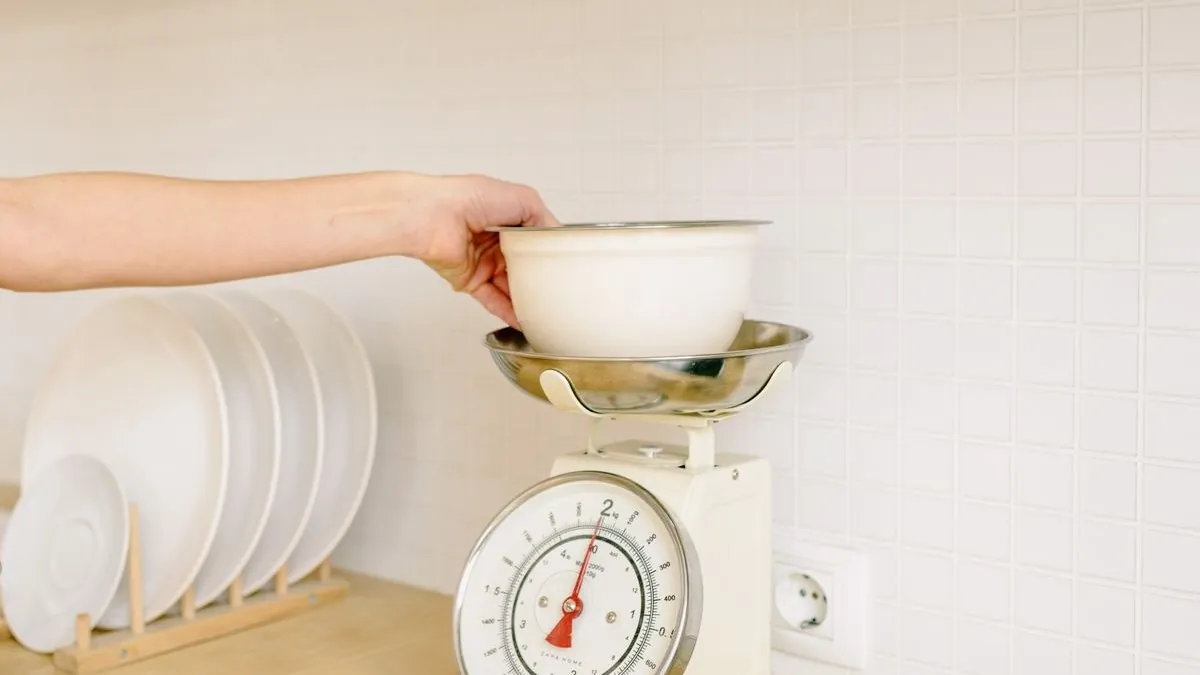
Weighing is one of the oldest technologies there is. Balance scales from Egypt, around 2000 BCE, compared goods against stone weights, and the idea barely changed for four thousand years: put the thing on one side, put known weights on the other, and see which way it tips.
The pound descends from the Roman libra, and the kilogram from the French Revolution — defined in 1799 as the weight of a litre of water, with a platinum cylinder made as the standard. For over a century that cylinder in Paris was, by definition, one kilogram.
In 2019 the kilogram was redefined by the Planck constant, a number from quantum physics, so it no longer depends on any lump of metal. The pound, fixed at exactly 0.45359237 kg since 1959, came along for the ride. The scales changed; the need to know how heavy something is never did.
5Worked examples: body weight, recipes, packages
Body weight, kg \u2192 lb. You weigh 70 kg and an American fitness app wants pounds: 70 \u00d7 2.20462 = 154.32 lb. The reverse: your US friend weighs 180 lb: 180 \u00d7 0.45359237 = 81.65 kg. (Or 180 \u00f7 2.20462 — same answer, pick whichever you remember.)
A recipe, grams \u2192 ounces. A European cake recipe calls for 250 g of flour; your American kitchen scale reads ounces: 250 \u00f7 28.3495 = 8.82 oz. And 500 g of pasta? 500 \u00f7 28.3495 = 17.64 oz — just over a pound (16 oz), which is why the "1 lb box" and the "500 g box" are near-twins on supermarket shelves.
A package, lb \u2192 kg. You're shipping a 12 lb parcel internationally and the courier prices in kilograms: 12 \u00d7 0.45359237 = 5.44 kg. Mental check with the shortcut: half of 12 is 6, a touch less \u2192 about 5.4 kg. Close enough to estimate, exact when it counts.
| Kilograms | Pounds | Pounds | Kilograms |
|---|---|---|---|
| 50 kg | 110.23 lb | 100 lb | 45.36 kg |
| 60 kg | 132.28 lb | 120 lb | 54.43 kg |
| 70 kg | 154.32 lb | 150 lb | 68.04 kg |
| 80 kg | 176.37 lb | 180 lb | 81.65 kg |
| 90 kg | 198.42 lb | 200 lb | 90.72 kg |
| 100 kg | 220.46 lb | 220 lb | 99.79 kg |
6The stone: Britain's stubborn survivor
Of all the imperial units, the stone is the strangest survivor. Fourteen pounds — exactly 6.35029 kg — and still the unit millions of Britons use for body weight. "I weigh eleven stone" means 154 lb (11 \u00d7 14), or 69.85 kg. Ask a Brit their weight in pounds and many will pause; ask in stone and the answer is instant.
Where did 14 come from? Medieval English trade: a "stone" of wool was standardized at 14 pounds centuries ago, and the unit stuck to people the way it stuck to sheep. The UK officially went metric decades ago, but bathroom scales still show stone, doctors still hear it, and no one is giving it up.
Converting is easy because 14 is exact: stone = pounds \u00f7 14, pounds = stone \u00d7 14. 154 lb \u00f7 14 = 11 stone exactly. 12.5 stone \u00d7 14 = 175 lb. And to kilograms: stone \u00d7 6.35029 — so 11 stone = 69.85 kg.
7In the kitchen: why grams beat cups
American recipes measure flour in cups; the rest of the world weighs it in grams. This isn't just tradition — grams are more accurate. A "cup of flour" can weigh anywhere from 120 g to 150 g depending on how you scoop it, a 25% swing that ruins delicate baking. 250 g of flour is 250 g of flour, every time, in every kitchen.
The conversions you'll use most: 1 oz \u2248 28.35 g, so a stick of butter (4 oz) is 113.4 g; a cup of water is 8 fl oz of volume, which weighs about 237 g — but don't confuse fluid ounces (volume) with ounces (weight), they're different units sharing a name. For dry ingredients, always convert via the recipe's gram weight if it's given; if it isn't, a kitchen scale set to grams is the single best $15 a baker can spend.
Handy kitchen anchors: 100 g \u2248 3.5 oz \u00b7 250 g \u2248 8.8 oz \u00b7 500 g \u2248 1.1 lb \u00b7 1 kg \u2248 2.2 lb. Tape them inside a cabinet door and you'll stop converting entirely — you'll just know.
One more kitchen skill: scaling recipes across systems. A US recipe serving 4 calls for 8 oz of chicken per serving? That's 8 \u00d7 28.3495 = 226.8 g per serving, or about 907 g total — just under a kilo, so buy the 1 kg pack and you'll have a little extra. And when a European recipe says "500 g flour" and your American measuring cups are all you have, remember the flour caveat: 500 g of all-purpose flour is roughly 4 cups spooned and leveled, but anywhere from 3\u00bd to 4\u00bd cups scooped. The grams were the recipe's way of protecting you from exactly that variance — which is why serious bakers convert the recipe once, write the gram weights in the margin, and never look back.
8Luggage and shipping: where grams become dollars
Weight conversion gets financial the moment you travel or ship. Airlines price checked bags by the kilogram (or pound), and the overage fees are designed to hurt.
The magic luggage numbers: the standard international checked-bag limit is 23 kg = 50.7 lb; the generous one (business class, some US carriers) is 32 kg = 70.5 lb; typical cabin carry-on is 7–10 kg = 15.4–22 lb. Memorize 23 kg \u2248 51 lb and you'll never be the person repacking at the check-in counter.
Shipping works the same way in reverse: US carriers quote pounds, international legs bill kilograms. A 12 lb box is 5.44 kg; a 5 kg parcel is 11.02 lb. And watch the tonne vs ton trap: a metric tonne is 1,000 kg (2,204.62 lb), while a US ton is 2,000 lb (907.18 kg) — about 10% lighter. In freight quotes, that 10% is real money.
| Situation | Limit | Converted | What it means |
|---|---|---|---|
| Checked bag (standard) | 23 kg | 50.7 lb | The world's most common limit |
| Checked bag (generous) | 32 kg | 70.5 lb | Business class / US carriers |
| Carry-on | 7 kg | 15.4 lb | Weigh it packed — they do |
| USPS international | 4 lb | 1.81 kg | First-class package cutoff |
| Metric tonne | 1,000 kg | 2,204.62 lb | International freight |
| US ton | 2,000 lb | 907.18 kg | ~10% less than a tonne |
9Mistakes everyone makes (and the 2-second checks)
Multiplying when you should divide. 70 kg isn't 154 lb because you multiplied by something smaller than 1 — pounds are the smaller unit, so there are more of them: multiply kg by 2.2. Sanity check: kg \u2192 lb makes the number bigger (multiply), lb \u2192 kg makes it smaller (divide). If your answer breaks this, you went the wrong way.
Confusing ounces of weight with fluid ounces. An 8 oz steak weighs 8 ounces; an 8 fl oz cup holds 8 fluid ounces of volume. For water they're nearly the same — for honey, oil or flour they're not. Recipes that say "8 oz" for a liquid usually mean fluid ounces; for a solid, weight ounces.
Stone without the 14. Hearing "12 stone" and converting as if it were 12 pounds gives you 5.4 kg — the weight of a housecat, not a human. Stone \u00d7 14 = pounds, always.
Tonne vs ton. Covered above, but it bears repeating: in any freight, vehicle or industrial context, confirm which ton. A 10% error on a 20-tonne shipment is 2,000 kg of surprise.
10Our free converter: every unit, one box
Our weight converter handles all seven units — milligrams, grams, kilograms, tonnes, ounces, pounds and stone — in one clean interface. Type a value, pick the units, and the full conversion grid updates instantly, so you can see your 70 kg as 154.32 lb, 11 stone 0.3, and 70,000 g all at once.
The swap button flips the direction; everything runs in your browser with no account and no tracking.
Convert any weight unit — free
kg, lb, oz, g, stone and more — exact factors, instant results, full comparison grid.
\u2696 Open the Weight Converter100% free \u00b7 No account \u00b7 Private by Qevryn
11Frequently asked questions
How many pounds are in a kilogram?
One kilogram equals 2.20462 pounds (often rounded to 2.2). So 70 kg \u00d7 2.20462 = 154.32 lb. The pound is defined as exactly 0.45359237 kg, so the relationship is exact.
How do I convert pounds to kilograms?
Multiply by 0.45359237 (or divide by 2.20462). For example, 150 lb \u00d7 0.45359237 = 68.04 kg. For a quick estimate, halve the pounds and shave a little off — 150 lb \u2248 68 kg.
What is a stone in weight?
A stone is 14 pounds — exactly 6.35029 kg. It's still widely used for body weight in the UK and Ireland. 11 stone = 154 lb = 69.85 kg.
Is weight the same as mass?
Strictly speaking, no — mass is the amount of matter (kilograms) and weight is the force gravity exerts on it (newtons, or pounds-force). In everyday life — cooking, luggage, fitness — the distinction doesn't matter and everyone treats them as the same.
How many grams are in an ounce?
One ounce is exactly 28.349523125 grams (usually rounded to 28.35 g). So 8 oz = 226.8 g, and 1,000 g \u00f7 28.3495 = 35.27 oz.
What's the difference between a tonne and a ton?
A metric tonne is 1,000 kg (2,204.62 lb); a US ton is 2,000 lb (907.18 kg) — about 10% less. In freight and vehicle contexts, always confirm which one the quote uses.
Keep exploring
Weight is just one corner of the toolbox. These related tools pair naturally with the guide above:
iLoveUnit is a Qevryn product — free, private, no signup.
Related guides
More step-by-step guides on this topic: