

What you can do with this tool
- Read your weight in the unit you think in: 150 lb is 68 kg — no mental maths.
- Follow a recipe or a fitness plan: pounds in the book become kilos on your scale.
- Check luggage limits: airline kilos and bathroom-scale pounds finally match.
- Track your weight loss: one number, both units, every time you step on the scale.
It takes seconds — and the rest of this guide shows you how the exact factor works.
Use the free Pounds to Kilograms Converter: convert pounds to kilograms instantly, with the exact 0.45359237 factor — open the converter →
📌 Key takeaways
- The formula: kilograms = pounds × 0.45359237.
- One pound is 0.45359237 kg: one kilogram is 2.20462 lb.
- 150 lb is 68.04 kg: 100 lb is 45.36 kg.
- One exact number connects them: no rounding, no guessing.
⚖️ Pounds to Kg — at a glance
The key numbers from this guide, in one place.
If you have ever stepped on a scale in the US and then tried to make sense of the number back home, you know the problem. Your weight is 150 lb in one country and 68 kg in another — same body, two numbers. The pounds-to-kilograms converter exists so you never have to do that maths in your head again. Type in pounds, get kilograms, done in a second.
This guide covers the exact conversion factor, a worked example you can check by hand, a quick reference table, and the small mistakes that cause most wrong answers. By the end you will be able to convert in your head to a rough answer and use the tool for the exact one.
1What is a pound? What is a kilogram?
A pound (lb) is the unit of weight used in the United States and, for body weight, still widely in the UK. It comes from the old Roman libra, which is why the abbreviation is "lb" and not "pd". A kilogram (kg) is the base unit of mass in the metric system, used by almost every other country on Earth and by science everywhere.
Both measure the same thing — how much matter something has — but they were defined independently, so there is no neat round number between them. The two systems meet at one fixed point: 1 pound equals exactly 0.45359237 kilograms. That number is set by international agreement, so it never changes and no country has its own version of it.
You will meet this conversion most often with body weight, luggage allowances, gym weights, and recipes. Airlines quote baggage in both units, fitness apps let you pick either, and a recipe from an American site will list butter in pounds while your kitchen scale reads grams. Knowing the factor once saves you from guessing every time.
2How to use the converter
The tool is built for speed — three steps and you have your answer:
- Enter your pounds. Type the number into the pounds box. Decimals are fine — 150.5 lb works just like 150 lb.
- Check the result. The kilogram value appears instantly. There is no button to press and no page to reload.
- Round sensibly. For body weight, one decimal place (68.0 kg) is plenty. For luggage or shipping, two decimals are usually enough.
You can also work the other way round. If you have kilograms and want pounds, multiply by 2.20462 — or use the kilograms-to-pounds converter, which does the same job in reverse. The two tools are a matched pair, and either one gets you there.

3The formula, with a worked example
The maths is a single multiplication:
And in reverse:
Let us run a real example by hand. Say you weigh 150 lb and want to know your weight in kilograms:
Step by step: 100 lb × 0.45359237 = 45.36 kg, and 50 lb × 0.45359237 = 22.68 kg. Add them: 45.36 + 22.68 = 68.04 kg.
Here is a short table for the numbers people look up most:
| Pounds (lb) | Kilograms (kg) |
|---|---|
| 10 lb | 4.54 kg |
| 50 lb | 22.68 kg |
| 100 lb | 45.36 kg |
| 150 lb | 68.04 kg |
| 200 lb | 90.72 kg |
Notice the pattern: every 10 lb adds about 4.54 kg. Once you remember that 10 lb is roughly 4.5 kg, you can estimate any value by counting in tens and the tool handles the exact decimals.
4A short history of the pound and the kilogram
The pound comes from Rome. The libra was the Roman unit of weight, and its abbreviation, lb, still labels pounds today. The avoirdupois pound — 16 ounces — was standardised in England in the 1300s and carried around the world by British trade.
The kilogram comes from revolutionary France. It was defined in 1799 as the weight of a litre of water, and the Kilogramme des Archives, a platinum cylinder, was made as the physical standard. For over a century that cylinder in a Paris vault was, by definition, one kilogram.
The two were tied together in 1959, when the international agreement fixed the pound at exactly 0.45359237 kilograms. In 2019 the kilogram was redefined again — now by the Planck constant from quantum physics, with no metal lump involved — but the pound’s definition in kilograms did not change: 150 lb is still 68.04 kg.
5Common mistakes
- Dividing instead of multiplying. Pounds are smaller units than kilograms in count but the number in pounds is bigger — 150 lb is 68 kg. If your answer in kg is larger than your pounds, you divided the wrong way.
- Rounding the factor to 0.45 and trusting it for big numbers. Using 0.45 instead of 0.45359237 is fine for a quick guess, but on 500 lb it is off by nearly 2 kg. Use the full factor for anything that matters.
- Mixing up pounds and stones. In the UK, body weight is often given in stones and pounds (11 st 6 lb, for example). One stone is 14 lb, so convert stones to pounds first — or use the stone-to-kg converter, which handles both at once.
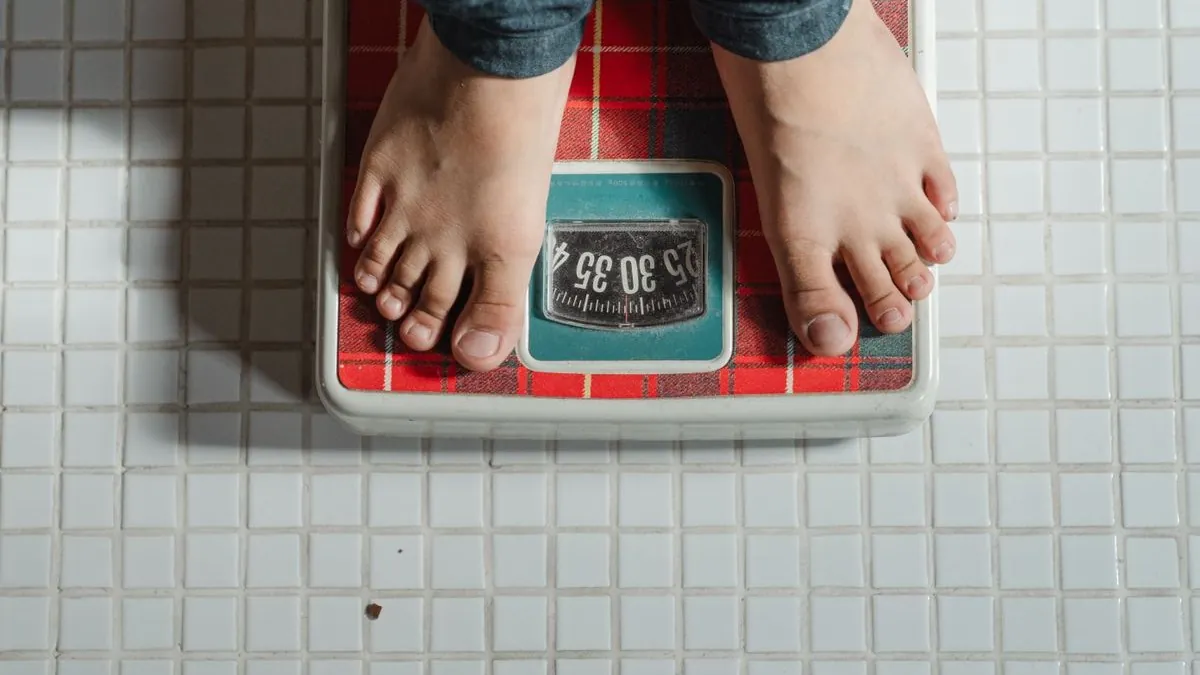
- Forgetting that scales vary. A bathroom scale can be off by a kilo or two. If the converted number looks surprising, weigh yourself twice and check the scale is on a hard, flat floor.
6Tips for everyday conversions
For luggage, check the airline limit in the same unit your scale uses before you pack — converting at the airport with a heavy bag is the worst time to do maths. For the gym, remember that a 45 lb plate is 20.4 kg, which is why plates marked 20 kg feel almost the same. For cooking, 1 lb of butter is 454 g, so a recipe calling for half a pound needs about 227 g — and the grams-to-cups converter can take you the rest of the way if the recipe uses volume instead.
If you convert the same numbers often, keep the two anchor points in mind: 2.2 lb ≈ 1 kg and 10 lb ≈ 4.54 kg. Between those two, you can estimate almost anything in seconds, and the converter is there whenever you want the exact figure.
One more situation where this conversion matters more than people expect: medicine and health. Drug doses are often calculated by body weight in kilograms, and a dose worked out in pounds by mistake can be dangerously wrong — which is why hospitals always weigh patients in kilograms, even in countries that use pounds in daily life. If you ever need to give a doctor your weight and you only know it in pounds, convert it first and give both numbers: "150 lb, which is 68 kg". The same applies to children's medicine, where doses are weight-based and the margin for error is smaller.
It is also worth keeping the conversion in mind when you travel. Luggage limits are the classic case — a 50 lb limit is 22.7 kg, and a bag that weighs 23 kg is over the limit even though 23 sounds like a small number next to 50. Weigh your bag at home in the unit the airline uses, and you will never pay an excess fee at the desk. The same goes for shipping parcels and for gym weights abroad: the numbers change, the weight does not, and one quick conversion keeps you on the right side of both.
Try the free Pounds to Kilograms Converter
Use the pounds to kilograms converter right now — free, no signup, and your numbers never leave your browser.
Try the free Pounds to Kilograms Converter100% free · No account · Private by Qevryn
7Frequently asked questions
How many kg is 1 lb?
One pound is exactly 0.45359237 kilograms. For a quick estimate, 1 lb is about 0.45 kg.
How do I convert pounds to kg in my head?
Halve the pounds, then subtract a tenth of the result. For 150 lb: half is 75, a tenth of 75 is 7.5, so 75 − 7.5 = 67.5 kg — very close to the exact 68.04 kg.
Is 1 kg equal to 2.2 lb?
Almost. One kilogram is 2.20462 pounds, so 2.2 is a good rough figure and 2.20462 is the exact one.
Why is the factor 0.45359237?
It is set by international agreement: the pound is defined as exactly 0.45359237 kilograms, so the conversion is exact, not an approximation.
How many pounds is 70 kg?
70 kg × 2.20462 = 154.32 lb. So a person who weighs 70 kg weighs about 154 lb.
Should I round my weight in kg?
For body weight, one decimal place (68.0 kg) is plenty. For shipping or luggage, two decimals (68.04 kg) is the usual choice.
iLoveUnit is a Qevryn product — free, private, no signup.
Keep exploring
These tools go well with the pounds to kilograms converter:
Related guides
More step-by-step guides on this topic: