
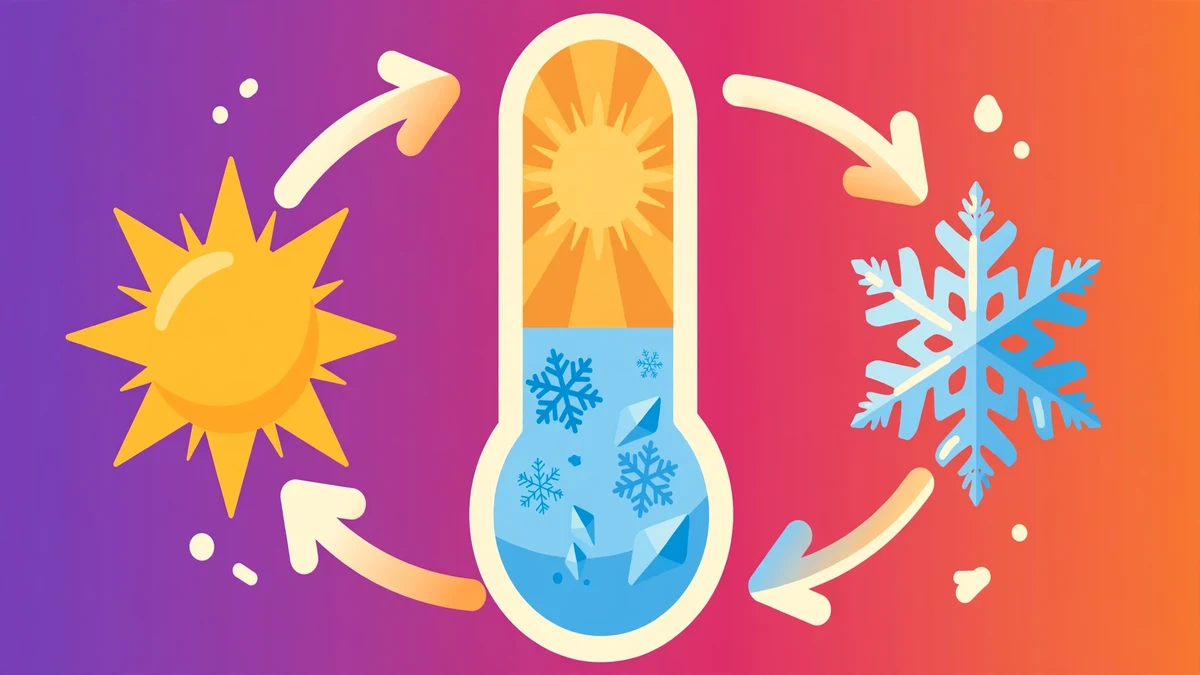
1What are Fahrenheit and Celsius?
Fahrenheit (°F) is the temperature scale used in the United States. Water freezes at 32°F and boils at 212°F. It dates from the early 1700s, when Daniel Fahrenheit built one of the first reliable thermometers and set its scale using a brine solution and body temperature — which is why the anchor points look odd today.
Celsius (°C) is the scale used by almost every other country, and by all of science. Water freezes at 0°C and boils at 100°C — neat numbers, which is why it won everywhere else.
The two scales differ in two ways: they start at different points (32°F is 0°C), and their degrees are different sizes (one Celsius degree equals 1.8 Fahrenheit degrees). Converting needs both a subtraction and a division, which is why it feels harder than it is.
2How to use the Fahrenheit to Celsius converter
Five seconds:
- Type the Fahrenheit temperature into the box — decimals and negatives both work.
- Read the Celsius result instantly.
- Flip it if you need Celsius back to Fahrenheit.
Use it for American recipes ("bake at 350°F"), US weather forecasts, and anything with an American thermometer. If you are visiting the US or cooking from an American cookbook, this page earns its keep fast.
3The formula — with a worked example
Subtract 32, then multiply by 5/9:
77 − 32 = 45. Then 45 × 5/9 = 25°C.
So a warm 77°F day is 25°C.
The reverse is just as simple:
And remember the one point where the scales agree: −40. Minus 40°F is minus 40°C. It is the only temperature where no conversion is needed.
4Everyday temperatures in both scales
| What it is | °F | °C |
|---|---|---|
| Freezing point of water | 32 | 0 |
| A cold winter day | 14 | −10 |
| Fridge temperature | 39 | 4 |
| Room temperature | 68 | 20 |
| A warm day | 77 | 25 |
| A hot day | 95 | 35 |
| Human body temperature | 98.6 | 37 |
| Baking a cake | 350 | 177 |
| Boiling point of water | 212 | 100 |
Three anchors cover most of life: 32°F is freezing, 68°F is room temperature, and 98.6°F is body temperature. Learn those and the rest falls into place.
5Mistakes people make with temperature conversion
- Multiplying before subtracting. The order matters: subtract 32 first, then multiply by 5/9. Doing it backwards gives a wrong answer.
- Using the double-and-add shortcut backwards. The "double and add 30" trick converts Celsius to Fahrenheit. For the reverse, subtract 30 and halve — do not double.
- Forgetting that Fahrenheit degrees are smaller. A 10°F change is only about 5.5°C, so "10 degrees warmer" means different things on the two scales.
- Rounding oven temperatures wrong. American recipes use round Fahrenheit numbers (350°F), which convert to odd Celsius numbers (177°C). Round to the nearest 5°C — 175°C — and the recipe will be fine.
6Fahrenheit in daily American life
If you visit the United States, Fahrenheit is everywhere, and it shapes daily decisions in ways that surprise visitors. The weather forecast says 75°F and everyone calls it a nice day; it says 95°F and people stay indoors; it says 32°F and the roads ice over. Americans do not convert — they feel the numbers directly, because they grew up with them. A child in Ohio knows that 70 is pleasant and 100 is dangerous without ever doing the maths.
Thermostats are the second place you meet it. American homes are heated and cooled in Fahrenheit, and the numbers on the dial are the ones people argue about: 68°F in winter, 72°F in summer, and the endless household debate over two degrees. A visitor who sets the thermostat to 25 — thinking Celsius — will get a house at 25°F, which is -4°C, and a very cold night. Always check which scale the dial uses.
Cooking is the third. American ovens are marked in Fahrenheit, American recipes call for 350°F, and American cooks know that 350 is the standard baking temperature the way the rest of the world knows 180°C. Meat thermometers read in Fahrenheit too: chicken is done at 165°F, a medium steak at 145°F. If you are cooking from an American recipe, the converter on this page is your best friend — but after a few weeks, 350°F starts to feel like 180°C without any conversion at all.
Finally, there is the fever check. An American thermometer reads 98.6°F for a healthy adult and 100.4°F for a fever — the line where doctors start paying attention. If you are caring for a child in the US, that 100.4°F number is the one to remember. It is 38°C, the same fever line the rest of the world uses, just written in a different scale.
7Reading an American weather forecast
American weather forecasts are written in Fahrenheit, and they use a vocabulary that goes with the numbers. A forecast of 70°F with a light breeze is a pleasant day. At 85°F, people talk about heat. At 95°F, there are heat warnings, and outdoor work becomes dangerous. At 100°F, schools and workplaces take precautions. And at 32°F, the freezing point, roads ice over and pipes can burst.
The forecast also talks about wind chill and heat index, both in Fahrenheit. Wind chill is how cold it feels when the wind blows — a day at 20°F with a strong wind can feel like 0°F. Heat index is the reverse: how hot it feels when humidity is high — 90°F with high humidity can feel like 105°F. Both are calculated from the temperature and the wind or humidity, and both are reported in Fahrenheit, so converting them needs the same formula as the temperature itself.
For a visitor, the practical rule is simple: 60–75°F is comfortable, 75–85°F is warm, 85–95°F is hot, and above 95°F is dangerous without shade and water. Below 40°F you need a coat, below 32°F you need to worry about ice, and below 0°F you need to worry about exposed skin. Those bands cover almost every forecast you will ever read, and once you know them, the numbers stop being a puzzle.
One last note: American forecasts often give the temperature as a range, such as "high 78, low 55." The high is the afternoon temperature, the low is the overnight one. Dress for the high if you are out in the day, and carry a layer for the evening when it drops to the low.
8Tips for thinking in both scales
Learn the oven numbers. The common American baking temperatures convert to these Celsius figures: 325°F is 165°C, 350°F is 175°C, 375°F is 190°C, and 400°F is 200°C. Memorise those four and you can cook from any American recipe.
Use the 10-degree steps. Every 18°F is 10°C. So 50°F is 10°C, 68°F is 20°C, 86°F is 30°C. Those three anchors cover most weather.
Read the forecast in both. Next time you check the weather, look at both scales for a week. By the end of it, 70°F will feel like 21°C without any maths.
Remember −40. It is the one temperature that is identical on both scales, and a handy check that your conversion is working.
Convert Fahrenheit to Celsius — try the free converter
Type any Fahrenheit temperature and get the exact Celsius instantly — weather, ovens, science, whatever you need.
🌡️ Open the Fahrenheit to Celsius Converter100% free · No account · Private by design
9Frequently asked questions
What is the formula for Fahrenheit to Celsius?
Subtract 32, then multiply by 5/9. So °C = (°F − 32) × 5/9. For example, 77°F minus 32 is 45, times 5/9 is 25°C.
What is 350°F in Celsius?
350°F is about 177°C — the standard baking temperature, usually rounded to 175°C in metric recipes.
What is 98.6°F in Celsius?
98.6°F is 37°C — normal human body temperature.
Why does the US use Fahrenheit?
The scale was set in the early 1700s and was standard in the British Empire before Celsius took over elsewhere. The US kept it, so Americans still use it for weather, cooking and thermostats.
Is 0°F the same as 0°C?
No. 0°F is −17.8°C, a bitterly cold day. 0°C is 32°F — the freezing point of water. The two scales only meet at −40.
How do I convert Celsius to Fahrenheit?
Multiply by 9/5 (1.8) and add 32. So °F = (°C × 1.8) + 32. For example, 25°C × 1.8 = 45, plus 32 = 77°F.
Keep exploring
Temperature is one conversion travellers need constantly. These are the others: