
Area — the quick answer
Area measures two-dimensional space — the size of a surface. Choose a shape, enter its dimensions, and get the area instantly in cm², m², in², ft², yd² or acres.
Six shapes are covered: square (s²), rectangle (l×w), triangle (½bh), circle (πr²), trapezoid (½(a+b)h) and parallelogram (bh). The calculator works in square meters internally, then converts to your chosen unit.
A short history of measuring area
Area measurement began with farming and taxes — Egyptian "rope stretchers" re-surveyed Nile fields after each flood using knotted cords, effectively doing geometry with rope. The word geometry itself means "earth measurement" in Greek.
Archimedes (c. 250 BC) proved the circle's area equals πr² by slicing it into ever-thinner sectors — an early glimpse of calculus, some 1,900 years before Newton and Leibniz formalized it. His "method of exhaustion" pinned π between 3.1408 and 3.1429.
Land units fossilize old farming practice: an acre was the area a yoke of oxen could plow in a day (now fixed at 4,046.86 m²), and a roofer's "square" still means 100 ft². Metric areas — square meters and hectares — rationalized all of this in the 1790s.
How it works: the formulas
5 × 3 = 15 m² — a small bedroom floor.
π × 100 = 314.16 cm².
Area formula reference
Every shape on the calculator, with a worked example:
| Shape | Formula | Worked example |
|---|---|---|
| Square | A = s² | s = 4 → 16 |
| Rectangle | A = l × w | 5 × 3 → 15 |
| Triangle | A = ½ × b × h | b = 6, h = 4 → 12 |
| Circle | A = πr² | r = 5 → 78.54 |
| Trapezoid | A = ½(a + b) × h | a = 4, b = 6, h = 3 → 15 |
| Parallelogram | A = b × h | b = 7, h = 3 → 21 |
How big is that? Everyday areas
Areas you can picture, with the numbers behind them:
A 4 × 5 m room — typical for flooring or paint estimates.
Radius 15 cm → π × 225. Area, not diameter, sets the value.
About 75% of a football pitch, or roughly 16 tennis courts.
A square 100 m on each side — the metric land standard.
420 × 594 mm = 0.249 m² — half an A1 sheet.
105 × 68 m per FIFA standard dimensions.
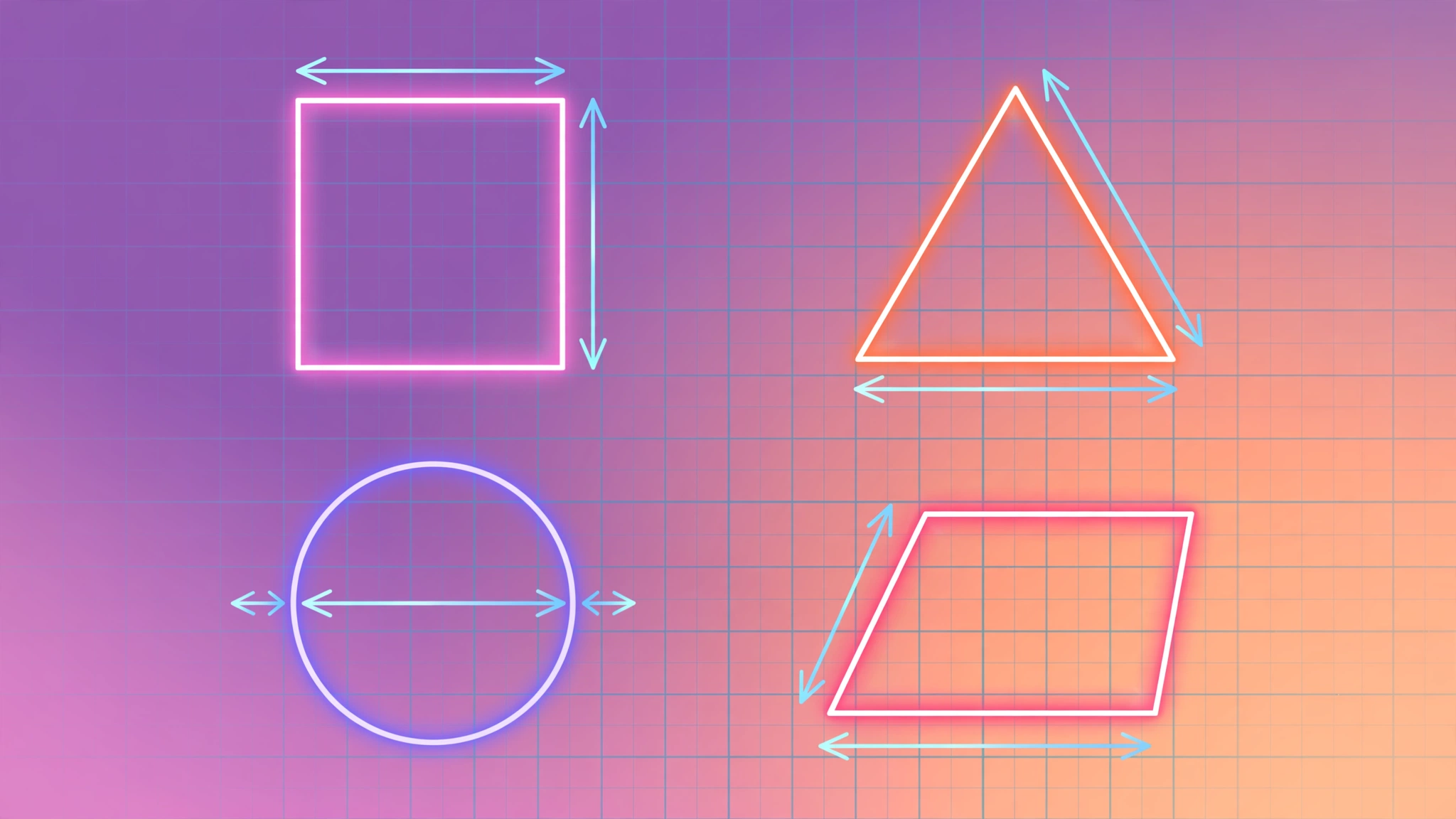
Visual guide: shapes and formulas
Rectangles and parallelograms are "length × height"; triangles and trapezoids take half; the circle brings π:
Figure: the six shapes this calculator covers. Rectangles and parallelograms are "length × height"; triangles and trapezoids take half; the circle brings π.
Common mistakes to avoid
Area errors hide in the units. These four are the classics:
- Using the diameter instead of the radius. In πr², halving matters twice — using the full diameter makes the area 4× too big.
- Forgetting to square the conversion. 1 m² = 10,000 cm², not 100. Area conversions square the linear factor — always.
- Confusing area with perimeter. Fencing a garden needs perimeter (meters); sodding it needs area (square meters). Different numbers, different units.
- Triangle: using a slanted side. The height must be perpendicular to the base — a slanted edge gives a wrong, too-large answer.
Pro tips & mental math
Field-tested habits for measuring real spaces:
- Paint coverage first. Divide wall area (m²) by the can's stated m²-per-liter — then add 10% for waste and touch-ups.
- Split L-shaped rooms. Divide any awkward floor plan into rectangles, calculate each, and add. It always works.
- Remember the anchors: 1 acre ≈ 4,047 m²; 1 hectare = 10,000 m² exactly = 2.471 acres.
- Circle shortcut: A ≈ 0.7854 × d² — handy when you measured the diameter, not the radius.
Printable cheat sheet
Print all six area formulas with worked examples — a clean, ink-friendly sheet with the widget and navigation hidden automatically:
Fun facts
- "Geometry" is Greek for "earth measurement" — the subject began as a practical tool for surveying fields, not an abstract puzzle.
- Archimedes' tomb was marked with a sphere inside a cylinder — his proudest discovery was that their volumes stand in a 2:3 ratio.
- A circle encloses the most area of any shape with a given perimeter — nature knows this, which is why bubbles and raindrops are round.
- The acre was "a day's plowing" for a yoke of oxen — one of the few units defined by agricultural labor rather than a king's body part.
The complete guide
The complete guide to area: rectangles, triangles, circles, trapezoids — every formula explained, acres and hectares, paint and flooring math, common mistakes — plus our free calculator.
Frequently asked questions
What is the difference between a square and a rectangle?
A square is a rectangle with all four sides equal, so its area is s². A general rectangle can have different length and width, so its area is l × w. Every square is a rectangle, but not every rectangle is a square.
Why is the triangle formula half of base times height?
Because a triangle is exactly half a parallelogram: two identical triangles placed base-to-base form a parallelogram of area b × h. One triangle is half of that — ½bh.
How is circle area different from circumference?
Area (πr²) measures the surface inside the circle; circumference (2πr) measures the distance around it. Double the radius and the circumference doubles — but the area quadruples.
How many square feet are in an acre?
43,560 ft² (4,046.86 m²). A handy mental image: an acre is roughly 75% of a standard football pitch, or about 16 tennis courts.
What units do I enter the dimensions in?
The linear version of your selected unit — centimeters for cm², feet for ft², yards for yd². When acres are selected (an area-only unit), enter dimensions in meters.
What is a hectare?
A hectare is 10,000 m² — a square 100 m on each side — equal to about 2.471 acres. It is the standard unit for land area in most metric countries.
Related tools
More calculators and converters you may find useful: