
1What area actually means (start from zero)
How much paint do you need for a wall? How much carpet for a room? How big is that plot of land, really? Every one of these questions is asking about area — the amount of flat surface something covers.
Here's the mental model that makes everything click: area counts how many unit squares fit inside a shape. A unit square is just a square measuring 1 × 1 — 1 inch by 1 inch, 1 foot by 1 foot, 1 meter by 1 meter. If 12 little 1-foot squares tile your floor exactly, the floor's area is 12 square feet (written ft²). That's why area units are always "square" something — you're literally counting squares.
This is also why area grows the way it does. Double the side of a square and you don't double the area — you quadruple it, because twice as many squares fit along each edge (2 × 2 = 4). It's the single most counterintuitive fact in the whole subject, and it bites people in real budgets: a 20-foot pizza isn't twice the pizza of a 10-foot pizza… well, it would be four times. (Nobody sells 20-foot pizzas, but the math is why the large always wins on value.)
The scaling rule generalizes: scale every linear dimension by k, and area scales by k². A map at half scale (k = 0.5) shows one-quarter the real area. Tiles 12 inches square cover four times the floor of 6-inch tiles — so you need one-quarter as many. Once you think in k², material estimates get much faster: double the tile size, quarter the tile count.
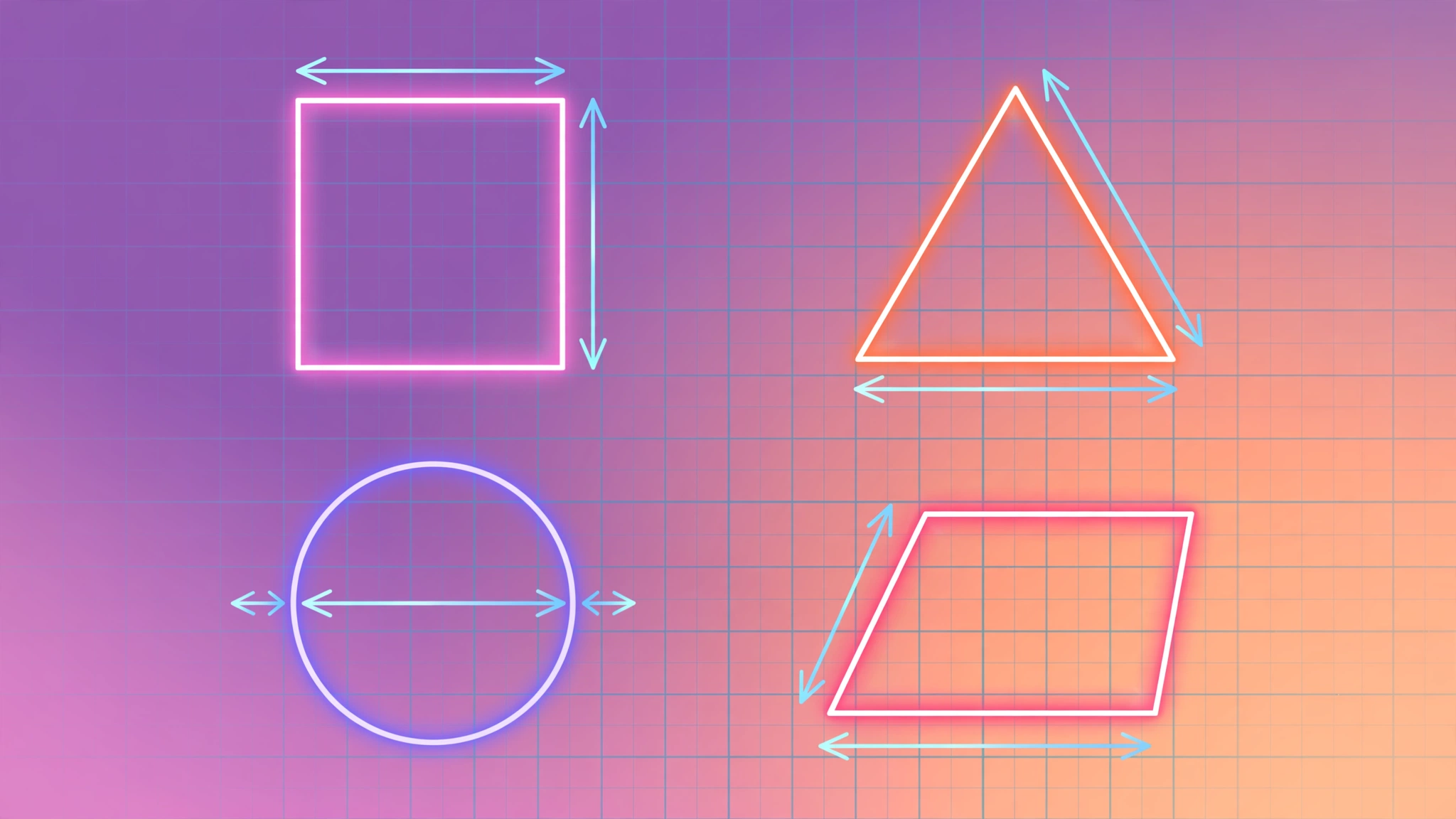
Our free area calculator handles six shapes — square, rectangle, triangle, circle, trapezoid and parallelogram — with every common unit. Type the dimensions, get the area, convert between units. This guide teaches you what it's doing under the hood, so the numbers mean something.
2Rectangles and squares: the foundation
Everything starts here, because every other area formula is secretly this one in disguise. A rectangle with length l and width w holds exactly l × w unit squares:
Square patio: 15 ft per side → 15² = 225 ft². A square is just a rectangle whose sides happen to be equal — every square is a rectangle, but not every rectangle is a square.
Notice the units multiply too: feet × feet = square feet. This "unit algebra" is your error detector — if your answer comes out in plain feet, you forgot to multiply two lengths somewhere. Area is always length × length, so the unit is always squared.
Real-world tip: measure twice, in the same units. A room measured as 12 ft by 120 inches is 12 × 10 = 120 ft² — but if you multiply 12 × 120 without converting, you get 1,440 of… something meaningless. Convert first, multiply second. Our calculator takes dimensions in the linear version of your chosen unit (feet for ft², centimeters for cm²) so this stays clean.
Odd-shaped rooms: split into rectangles
Real rooms are rarely perfect rectangles — L-shaped living rooms, alcoves, bay windows. The move: split the shape into rectangles, compute each area, and add. An L-shaped room might split into a 12×10 rectangle (120 ft²) plus an 8×6 rectangle (48 ft²) = 168 ft² total. For a room with a rectangular chunk missing (a closet jutting in), compute the big rectangle and subtract the missing piece. Addition for parts you have, subtraction for parts you don't — area is perfectly happy with both.
3Triangles: why half of base × height?
The triangle formula — A = ½ × base × height — looks arbitrary until you see the picture. Take any triangle, make an identical copy, flip it, and press the two together along their longest side. You get a parallelogram with area base × height. Your triangle is exactly half of it. Half the parallelogram, half the area: ½bh. That's the whole proof, and it's beautiful.
The trap is the word height. It doesn't mean "the slanted side" — it means the perpendicular distance from the base to the opposite corner. On a leaning triangle, the height drops straight down at 90° to the base, and it can even fall outside the triangle. Measure the slant edge by mistake and your area comes out too big. When in doubt: base is any side you choose, height is the perpendicular distance to the opposite vertex. Always perpendicular, no exceptions.
4Circles: πr² and its evil twin, circumference
The circle formula is the most famous in the subject:
Now the confusion to kill: area (πr²) vs circumference (2πr). Area measures the surface inside the circle; circumference measures the distance around it. Fencing a round garden? Circumference. Sodding it? Area. They share π and r but answer different questions — and they scale differently: double the radius and the circumference doubles, but the area quadruples (2² = 4). That scaling fact is worth memorizing; it shows up in engineering, cooking and construction budgets.
5Trapezoids and parallelograms: the rest of the family
Two more shapes round out the toolkit:
- Parallelogram: A = base × height. Same as a rectangle — imagine pushing a rectangle sideways; the area doesn't change as long as base and perpendicular height stay fixed. (Height is perpendicular, not the slanted side — same rule as triangles.)
- Trapezoid: A = ½ × (base₁ + base₂) × height. Average the two parallel sides, then it's just base × height. Think of it as a rectangle with the "average" width.
| Shape | Formula | Needs | Example result |
|---|---|---|---|
| Square | s² | side | s = 9 ft → 81 ft² |
| Rectangle | l × w | length, width | 12 × 10 ft → 120 ft² |
| Triangle | ½bh | base, perpendicular height | b = 24, h = 8 ft → 96 ft² |
| Circle | πr² | radius | r = 4 ft → 50.27 ft² |
| Parallelogram | b × h | base, perpendicular height | b = 10, h = 6 ft → 60 ft² |
| Trapezoid | ½(b₁+b₂)h | both bases, height | 10, 14, h = 6 ft → 72 ft² |
6Area in real life: paint, flooring, land and gardens
Area earns its keep in remarkably practical places:
- Painting. A gallon covers ~350–400 ft². A 12×10 room with 8-ft ceilings has wall area 2×(12×8) + 2×(10×8) = 352 ft², minus ~40 ft² for doors/windows → ~312 ft²: one gallon, with a bit to spare. Measure walls as rectangles, subtract openings as rectangles — area is just rectangles all the way down.
- Flooring. Tile, hardwood and laminate are priced per square foot. Pros add 10% waste for cuts (15% for diagonal patterns). That 120 ft² bedroom needs ~132 ft² of material.
- Land. The acre = 43,560 ft² (4,046.86 m²) — roughly 75% of a football field, or about 16 tennis courts. The hectare = 10,000 m² (a 100 m × 100 m square) ≈ 2.471 acres, the standard land unit across most of the metric world.
- Gardens and lawns. Seed, sod, fertilizer and mulch are all sold by coverage area. A 2,000 ft² lawn needs 2,000 ÷ 500 = 4 bags of a fertilizer rated at 500 ft² per bag.
- Construction. Drywall sheets (4×8 = 32 ft² each), roofing shingles (a "square" = 100 ft²), concrete slabs — the trades quote area because materials come in area.
- Solar panels. A panel's wattage divided by its area gives efficiency; roof area decides how many panels fit. Area × sunshine = power.
Wallpaper deserves its own note because it punishes sloppy area math. Rolls are sold by coverage (a US roll covers ~56 ft², a European roll ~53 ft²), but pattern repeats waste paper — a large repeat can eat 20–30% extra. Compute your wall area, subtract doors and windows, divide by the roll coverage, then round up and add one spare roll for future repairs. Running out mid-wall with a dye-lot mismatch is a special kind of heartbreak.
7Area units and conversions
Area units come in two flavors: squared length units (cm², m², in², ft², yd², mi²) and dedicated land units (acres, hectares). Converting between squared units means squaring the length conversion: 1 ft = 12 in, so 1 ft² = 12² = 144 in² — not 12. Forgetting to square is the classic conversion blunder.
| From | To | Multiply by | Memory hook |
|---|---|---|---|
| ft² | in² | 144 | 12² — square the 12 |
| yd² | ft² | 9 | 3² — square the 3 |
| m² | cm² | 10,000 | 100² |
| acre | ft² | 43,560 | The land classic |
| hectare | m² | 10,000 | 100 m × 100 m |
| hectare | acres | 2.471 | Metric → imperial land |
| mi² | acres | 640 | A section of farmland |
When acres are selected in our calculator (an area-only unit with no linear form), enter your dimensions in meters and it converts internally. For every other unit, enter the plain linear version — centimeters for cm², feet for ft², yards for yd².
8Mistakes that shrink (or explode) your answer
- Using diameter as radius. Halve the diameter first. Un-halved, your circle area comes out 4× too big.
- Measuring the slant instead of the height. Triangle, parallelogram, trapezoid heights are all perpendicular. The slanted edge is always longer — and always wrong here.
- Mixing units mid-calculation. Feet × inches = nonsense. Convert everything to one unit before multiplying.
- Forgetting to square conversions. 1 yd² = 9 ft², not 3. Square the linear factor, every time.
- Confusing area with perimeter/circumference. Fencing is perimeter (linear); covering is area (squared). They scale differently — doubling the radius doubles the fence but quadruples the sod.
- Skipping the waste factor. Real projects need 10–15% extra for cuts, mistakes and pattern matching. The math gives you the net; the store needs the gross.
Area of any shape in seconds — free
Squares, rectangles, triangles, circles, trapezoids and parallelograms — with acres, hectares and every square unit.
📐 Open the Area Calculator100% free · No account · Private by design
9Frequently asked questions
What is the difference between a square and a rectangle?
A square is a rectangle with all four sides equal, so its area is s². A general rectangle can have different length and width, so its area is l × w. Every square is a rectangle, but not every rectangle is a square.
Why is the triangle formula half of base times height?
Because a triangle is exactly half a parallelogram: two identical triangles placed base-to-base form a parallelogram of area b × h. One triangle is half of that — ½bh.
How is circle area different from circumference?
Area (πr²) measures the surface inside the circle; circumference (2πr) measures the distance around it. Double the radius and the circumference doubles — but the area quadruples.
How many square feet are in an acre?
43,560 ft² (4,046.86 m²). A handy mental image: an acre is roughly 75% of a standard football pitch, or about 16 tennis courts.
What units do I enter the dimensions in?
The linear version of your selected unit — centimeters for cm², feet for ft², yards for yd². When acres are selected (an area-only unit), enter dimensions in meters.
What is a hectare?
A hectare is 10,000 m² — a square 100 m on each side — equal to about 2.471 acres. It is the standard unit for land area in most metric countries.
Keep exploring
Area is half the story — the other half has depth. These tools complete the picture: