
Shoe sizes — the quick answer
There is no single world shoe-size standard. The US and UK systems count barleycorns (each 1⁄3 inch) but start counting from different zero points, the EU system counts Paris points (each 2⁄3 cm), and Japanese (JP/CM) sizing simply states your foot length in centimeters. That's why a US Men's 9 is a UK 8.5, an EU 42.5 and a 26.7 cm foot — all at once.
Pick your system in the converter above and see every other system instantly. Treat the results as approximate: brands grade their lasts differently, so the same "size 9" can fit differently from one maker to the next.
A short history: barleycorns, Paris points and the Brannock device
English shoe sizing starts with a grain of barley. In 1324, Edward II decreed that three barleycorns laid end to end equal one inch — and shoemakers began sizing shoes in barleycorn units of 1⁄3 inch. American sizes inherited the idea but shifted the zero point, which is why a US size and a UK size are always about half a size apart instead of identical.
Continental Europe went metric instead: the Paris point (2⁄3 cm, about 0.667 cm) became the EU standard, giving the familiar 38–47 numbering. Japan later cut through all of it with Mondopoint — now an ISO standard — which simply measures foot length in millimeters, the most honest system of all.
The metal foot-measurer in shoe stores has a name too: Charles Brannock invented the Brannock Device in 1925, and its sliding scales for length, width and arch are still the reference behind most US size charts today.
How it works: the conversion rules
Shoe sizes don't follow one neat formula — the US/UK scales aren't even perfectly linear against EU sizes. These anchors get you close; the chart does the rest:
EU and CM values come from the lookup chart, because those scales step unevenly:
The chart row for US 9 reads EU 42.5 (UK 8.5, foot length 26.7 cm).
EU 42 matches the US Men's 8.5 row exactly (26.2 cm foot) — the converter snaps to the nearest chart row automatically.
Shoe size conversion chart (US Men's 6–14)
Standard approximate chart. Remember: sizing varies by brand — always try before you buy.
| US Men's | US Women's | UK | EU | Foot length |
|---|---|---|---|---|
| 6 | 7.5 | 5.5 | 38.5 | 24.0 cm |
| 6.5 | 8 | 6 | 39 | 24.5 cm |
| 7 | 8.5 | 6.5 | 39.5 | 25.0 cm |
| 7.5 | 9 | 7 | 40.5 | 25.4 cm |
| 8 | 9.5 | 7.5 | 41 | 25.7 cm |
| 8.5 | 10 | 8 | 42 | 26.2 cm |
| 9 | 10.5 | 8.5 | 42.5 | 26.7 cm |
| 9.5 | 11 | 9 | 43.5 | 27.1 cm |
| 10 | 11.5 | 9.5 | 44 | 27.5 cm |
| 10.5 | 12 | 10 | 44.5 | 27.9 cm |
| 11 | 12.5 | 10.5 | 45 | 28.3 cm |
| 11.5 | 13 | 11 | 45.5 | 28.8 cm |
| 12 | 13.5 | 11.5 | 46 | 29.2 cm |
| 12.5 | 14 | 12 | 47 | 29.6 cm |
| 13 | 14.5 | 12.5 | 47.5 | 30.0 cm |
| 13.5 | 15 | 13 | 48.5 | 30.5 cm |
| 14 | 15.5 | 13.5 | 49 | 31.0 cm |
How big is it really? Foot lengths in everyday terms
Foot length in centimeters is the one measurement every system agrees on. Here's what common sizes actually measure, with everyday references:
A little longer than an A4 sheet is wide (21 cm).
Just over 10 inches — about the height of a standard paperback novel.
Roughly one and two-thirds US dollar bills laid end to end.
Only a couple of centimeters shy of a 12-inch (30.48 cm) ruler.
Practically identical to a standard school ruler — 11.8 inches.
Longer than a foot-long ruler — a full 12.2 inches of foot.
Visual guide: how foot length is measured
The CM (Japanese/Mondopoint) number is simply the heel-to-toe length of your foot. Stand — don't sit — with your weight evenly spread, and measure to your longest toe (which isn't always the big toe):
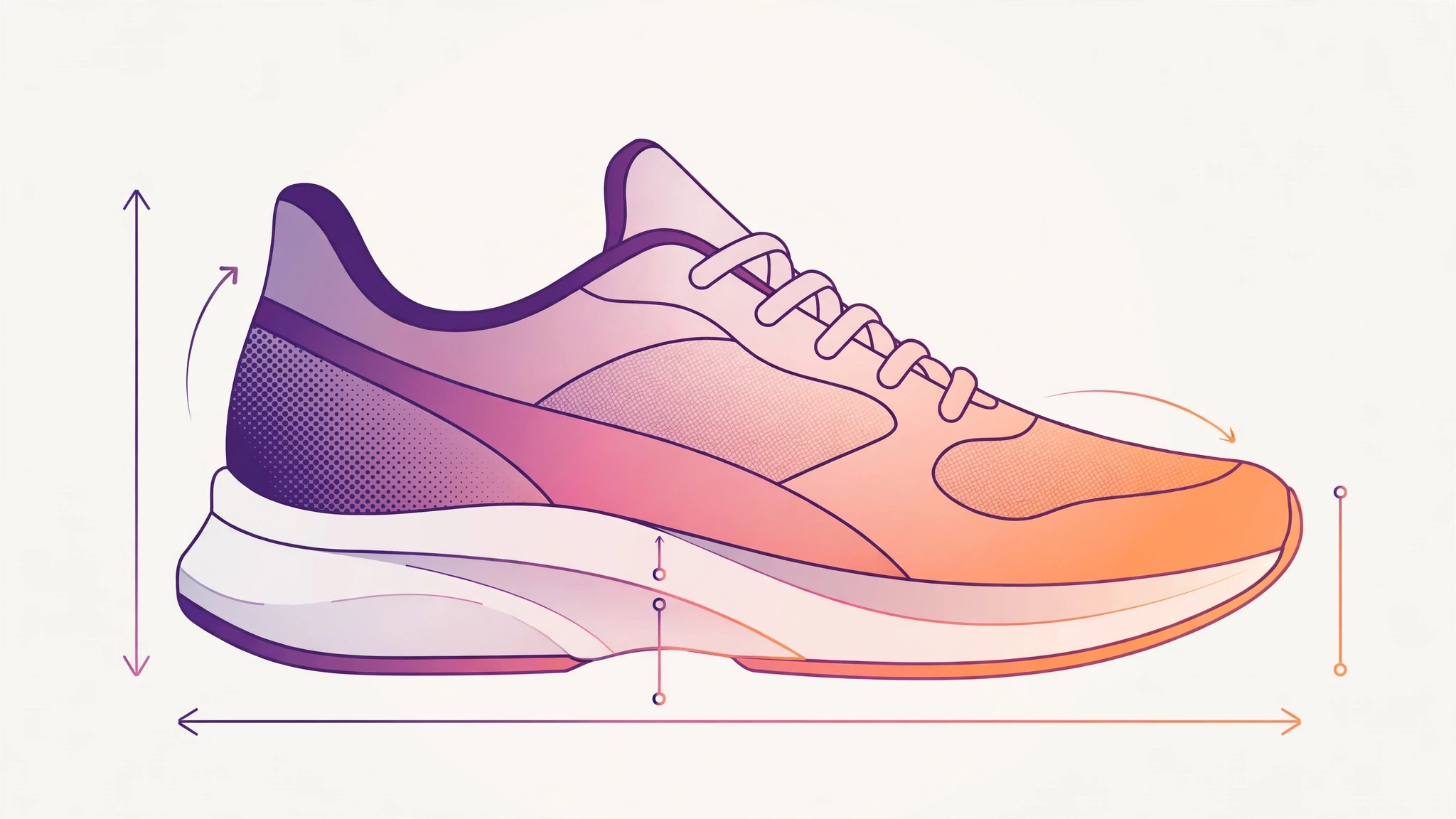
Figure: foot length is measured from the back of the heel to the tip of the longest toe. That number in centimeters is your Japanese (Mondopoint) size — the most reliable column in the chart.
Common mistakes to avoid
Shoe-size conversions go wrong in predictable ways. Dodge these four:
- Treating the chart as exact. Brands grade their lasts differently — a Nike 9 and a dress-shoe 9 can differ by half a size. Charts are approximate; reviews mentioning "runs small" are worth more than any table.
- Ignoring width. Length is only half the story. US widths run from AAA (narrow) to EEE (wide); if shoes pinch at the sides, you need a wider width, not a longer size.
- Measuring while sitting down. Feet spread under body weight, gaining up to half a size. Always measure standing, wearing the socks you'll actually use.
- Mixing up the women's offsets. US Women's = US Men's + 1.5, but UK women's sizes run about 2 below US women's. A US Women's 8 is roughly a UK 6 — don't apply the men's −0.5 rule to women's shoes.
Pro tips & measuring advice
Get a fit you can trust with these fitter-approved habits:
- Measure in the evening. Feet swell during the day — up to 5% larger by night. Evening measurements prevent shoes that fit at 9 am and pinch by 6 pm.
- Trace both feet, use the longer. Almost everyone's feet differ slightly. Fit the bigger foot; the smaller one will forgive you.
- Trust the CM column most. Foot length in centimeters is the only number that describes your actual foot. When systems disagree, the CM match wins.
- Leave a thumb's width. You want about 1 cm between your longest toe and the shoe's end. Between sizes? Size up — tight shoes don't stretch where it matters.
Printable cheat sheet
Take the full US 6–14 chart to the store. Print a clean, ink-friendly cheat sheet with one click — the page header, widgets and navigation are automatically hidden in the printout:
Fun facts
- Shoe sizes started with barley. Edward II's 1324 decree — three barleycorns to the inch — is the literal ancestor of every US and UK shoe size printed today.
- The EU's unit is French. The Paris point (2⁄3 cm) comes from 19th-century French shoemaking, which is why EU sizes march in such tidy two-thirds-of-a-centimeter steps.
- The Brannock Device is nearly a century old. Charles Brannock patented his foot-measurer in 1925 in Syracuse, New York — and the company still makes them in the same city.
- Japan measures feet, not shoes. Mondopoint — now ISO 9407 — records foot length in millimeters, which is why it's also the standard for military and ski boots worldwide.
The complete guide
The guide covers US, UK, EU and CM size charts, why sizes differ between brands, and how to measure your feet at home.
Frequently asked questions
Why do US, UK and EU shoe sizes differ?
They were invented independently on different bases. US and UK sizes count barleycorns (1/3 inch) from different zero points, while EU sizes count Paris points (2/3 cm). Japanese sizing skips the history entirely and just uses foot length in centimeters.
What is the difference between US and EU shoe sizes?
They run on completely different scales, so there is no fixed formula — for example, a US Men's 9 is roughly an EU 42.5. Use the conversion chart above rather than guessing.
How do I measure my foot for shoe size?
Stand (don't sit) on a sheet of paper in the evening, trace around your foot, and measure from heel to longest toe in centimeters. Match that number to the CM column in the chart — it is the most reliable sizing system.
What does JP or CM sizing mean?
Japanese (Mondopoint) sizing is simply your foot length in centimeters — a size 27 means a 27 cm foot. It is the most direct system because it describes your actual foot instead of an arbitrary number.
Are shoe sizes the same across brands?
No. Sizing varies by brand, model and even country of manufacture, so every conversion chart is approximate. When in doubt, try the shoes on — or order two sizes when shopping online.
Related tools
More converters for measurements and the body: