
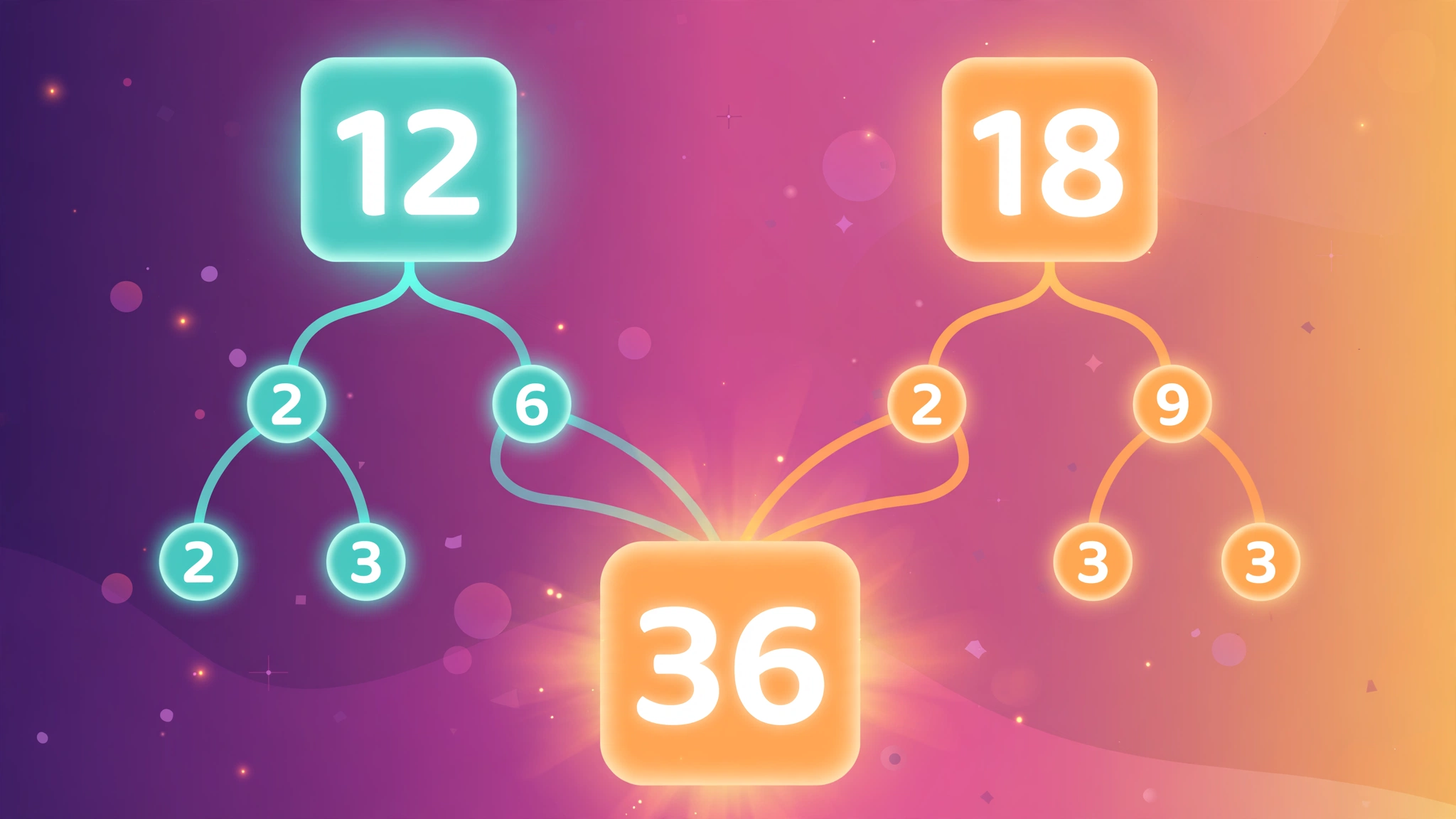
1What the LCM actually is (start from zero)
Take the number 4. Its multiples — the numbers you get by multiplying it by 1, 2, 3, 4… — are 4, 8, 12, 16, 20, 24, and so on, forever. Now take 6: its multiples are 6, 12, 18, 24, 30… Notice that 12 shows up in both lists, and so does 24. These shared numbers are called common multiples. The smallest one — 12 — is the least common multiple, or LCM.
That's the whole concept: the LCM of two (or more) numbers is the smallest number that all of them divide into evenly. It's "least" because there are infinitely many common multiples (24, 36, 48… all work for 4 and 6), and "common" because it belongs to every number's multiple list. LCM(4, 6) = 12.
Why would anyone care about the smallest shared multiple? Because it shows up constantly in real life. Two buses leave the station every 12 and 18 minutes — when do they leave together? That's LCM(12, 18) = 36 minutes. You're adding 1/4 and 1/6 of a recipe — what denominator do they share? LCM(4, 6) = 12. Two gears with 12 and 18 teeth — after how many rotations do the same teeth meet again? LCM again. Whenever repeating cycles need to sync up, the LCM is the answer.
There's a sibling concept you'll meet alongside it: the GCF (greatest common factor) — the biggest number that divides into both numbers. For 12 and 18, the GCF is 6 and the LCM is 36. They're mirror images: GCF looks down at shared divisors, LCM looks up at shared multiples. And as you'll see in section 3, they're secretly the same calculation wearing two hats.
2Three ways to find the LCM (pick your favorite)
There are three standard methods, and they all give the same answer. Learn all three — different situations call for different tools.
Method 1: List the multiples
The most obvious approach: write out multiples of each number until you spot a match. For 4 and 6: multiples of 4 are 4, 8, 12, 16, 20… and multiples of 6 are 6, 12, 18… First match: 12. Done. This is perfect for small numbers and for building intuition — it's literally what the definition says. It gets tedious past about 20, though, which is where the next methods earn their keep.
Method 2: Prime factorization
Break each number into prime factors, then build the LCM by taking each prime at its highest power across all the numbers:
Why does this work? The LCM has to contain every prime factor each number needs, at the full strength each number needs it. Taking the max power of each prime is exactly "enough for everybody, nothing extra." It's the method teachers love because it doubles as prime-factorization practice.
Method 3: The GCF shortcut (fastest)
Here's the elegant one — the LCM and GCF are linked by a single formula:
For 12 and 18: (12 × 18) ÷ 6 = 216 ÷ 6 = 36. The GCF itself is fast to find with the Euclidean algorithm (repeated division: 18 ÷ 12 leaves 6, 12 ÷ 6 leaves 0, so GCF = 6). This is the method computers use — and the one our calculator runs under the hood — because it stays fast even with huge numbers where listing multiples would take forever.
| Method | Best when | Example: LCM(12, 18) | Speed |
|---|---|---|---|
| Listing multiples | Numbers under ~20, learning the concept | 4, 8, 12… / 6, 12… → 12 for (4,6) | Slow for big numbers |
| Prime factorization | Homework, showing your work | 2² × 3² = 36 | Medium |
| GCF formula | Big numbers, mental math, programming | (12 × 18) ÷ 6 = 36 | Fast |
3The GCF connection (and why it matters)
The formula LCM(a, b) = |a × b| ÷ GCF(a, b) looks like a magic trick, so let's demystify it. Think of a × b as the "obvious" common multiple — 12 × 18 = 216 is definitely a multiple of both 12 and 18. But it's bloated: it counts every shared prime factor twice. Dividing by the GCF strips out exactly one copy of the overlap, leaving the smallest multiple that still covers both numbers. For 12 and 18, the overlap is 6, and 216 ÷ 6 = 36.
This gives you a lovely sanity check: LCM × GCF = a × b, always. If your LCM(12, 18) = 36 and GCF = 6, then 36 × 6 = 216 = 12 × 18 ✓. Anytime your answers fail this check, one of them is wrong — it's the fastest way to catch an arithmetic slip on a test.
There's a special case worth knowing: when the GCF is 1, the numbers are coprime — they share no prime factors at all. Then the formula collapses to LCM = a × b, no division needed. LCM(7, 5) = 35, LCM(8, 9) = 72. If you spot coprime numbers, you can skip straight to the product.
4LCM of three (or more) numbers
Real problems rarely stop at two numbers. Three delivery trucks run 4-day, 6-day and 8-day routes — when do all three hit the depot on the same day? You need LCM(4, 6, 8). The trick is beautifully simple: fold them in one pair at a time.
Order doesn't matter (LCM is associative, if you want the fancy word), but there's a practical tip: start with the pair that looks easiest. If one number is a multiple of another, that pair collapses instantly (see the next section), which simplifies everything downstream. Our calculator handles multi-number LCMs with this exact chaining, so you can throw any set of numbers at it.
A common mistake: multiplying all three numbers together (4 × 6 × 8 = 192) and calling it the LCM. That's a common multiple, sure — but it's eight times bigger than the real answer. On a scheduling problem, that's the difference between "every 24 days" and "every 192 days." Always reduce pairwise instead.
5Shortcuts and special cases
A few patterns let you skip the work entirely once you recognize them:
- One number divides the other → the LCM is the bigger number. Since 18 is a multiple of 6, every multiple of 18 is automatically a multiple of 6 — so LCM(6, 18) = 18. No calculation needed. This comes up constantly with fraction denominators.
- Coprime numbers → the LCM is their product. 7 and 5 share nothing, so LCM(7, 5) = 35. Same for 8 and 9 → 72.
- One of the numbers is 1 → the LCM is the other number. Trivial, but it falls out of the rules naturally.
- Equal numbers → the LCM is the number itself. LCM(9, 9) = 9. Obvious once stated, easy to overthink on a test.
What about zero and negatives? The LCM is defined for positive integers — that's why our calculator asks for whole numbers of 1 or greater. Some textbooks define LCM(0, n) = 0, but it's useless for scheduling or fractions (a "0-minute" bus route means nothing), so it's excluded in practice. Negative numbers are just converted to their absolute values first: LCM(−4, 6) = LCM(4, 6) = 12.
6The classic use: adding fractions
If you only ever use the LCM once, it'll probably be here. You can't add 1/4 + 1/6 directly — the pieces are different sizes. You need a common denominator, and the LCM gives you the smallest one, which keeps the numbers manageable.
The same idea runs subtraction, and it generalizes: any time you're combining quantities measured in different "chunk sizes," the LCM finds the chunk size they share. Bakers scaling recipes, carpenters combining fractional measurements, pharmacists mixing ratios — it's the same move.
Try a three-fraction warm-up: 1/4 + 1/6 + 1/8. LCM(4, 6, 8) = 24 (from section 4). Convert: 6/24 + 4/24 + 3/24 = 13/24. Clean, no simplifying needed. Once the denominator habit is automatic, fraction arithmetic stops feeling like guesswork.
7LCM in the real world: schedules, gears and rhythms
Beyond the classroom, the LCM is the math of things that repeat on different cycles. Here are the places it actually earns its keep:
- Transit schedules. Bus A every 12 minutes, Bus B every 18 — they coincide every LCM(12, 18) = 36 minutes. Transit planners use this to design timed transfers.
- Shift rotations. One crew works a 4-day rotation, another a 6-day rotation — they share a day off together every 12 days. Factories and hospitals live by this math.
- Gears and machinery. Two meshed gears with 12 and 18 teeth return to the same tooth-to-tooth alignment every 36 tooth-passages. Engineers use LCM to predict wear patterns — the teeth that meet most often wear fastest.
- Music. A 3-beat pattern played against a 4-beat pattern lines up every 12 beats. Polyrhythms in drumming and electronic music are LCM made audible.
- Planetary alignments. If planet X orbits every 4 years and planet Y every 6, they line up with the star every 12 years (simplified, but the principle is real — astronomers call these resonances).
- Baking and batch cooking. One recipe makes batches of 8, another of 12 — to make equal total portions, cook LCM(8, 12) = 24 of each (3 batches of the first, 2 of the second).
8Mistakes that cost marks (and how to dodge them)
- Confusing LCM with GCF. The classic. LCM is the smallest number both divide into (big — at least as big as the numbers); GCF is the biggest number that divides both (small — at most the smaller number). For 12 and 18: LCM = 36, GCF = 6. If your "LCM" is smaller than your inputs, you've found the GCF by accident.
- Multiplying everything together. a × b is a common multiple, not the least one (unless they're coprime). For 12 and 18, 216 "works" but 36 is the answer.
- Forgetting to reduce fractions first. When the LCM feeds a fraction problem, an unreduced intermediate can snowball. Always simplify at the end — or better, use the least multiple from the start.
- Using the LCM formula with a wrong GCF. LCM(a,b) = a×b ÷ GCF only works with the greatest common factor. Divide by a non-greatest factor and you'll land on a multiple that isn't least.
- Assuming the bigger number is always the LCM. It is only when the bigger is a multiple of the smaller. LCM(8, 12) = 24, not 12.
| Pair | GCF | LCM | Check: GCF × LCM = a × b |
|---|---|---|---|
| 4, 6 | 2 | 12 | 2 × 12 = 24 = 4 × 6 ✓ |
| 12, 18 | 6 | 36 | 6 × 36 = 216 = 12 × 18 ✓ |
| 7, 5 | 1 | 35 | 1 × 35 = 35 = 7 × 5 ✓ |
| 8, 9 | 1 | 72 | 1 × 72 = 72 = 8 × 9 ✓ |
| 6, 18 | 6 | 18 | 6 × 18 = 108 = 6 × 18 ✓ |
| 4, 6, 8 | — | 24 | LCM(4,6)=12, LCM(12,8)=24 ✓ |
Find any LCM instantly — free
Two numbers or ten — get the least common multiple (and the GCF) with the steps shown. No signup, runs in your browser.
🔢 Open the LCM Calculator100% free · No account · Private by design
9Frequently asked questions
What is the difference between LCM and GCF?
The LCM (least common multiple) is the smallest number both numbers divide into evenly — it is always at least as big as the numbers themselves. The GCF (greatest common factor) is the largest number that divides both — always at most as big as the smaller number. For 12 and 18: LCM = 36, GCF = 6. They're linked: LCM × GCF = a × b.
How do I find the LCM of three numbers?
Work pairwise: LCM(a, b, c) = LCM(LCM(a, b), c). Example: LCM(4, 6, 8) = LCM(12, 8) = 24. The same chaining works for four or more numbers — just keep folding the running answer with the next number.
What is the LCM if one number is a multiple of the other?
The larger number itself. Since 18 is a multiple of 6, every multiple of 18 is automatically a multiple of 6 — so LCM(6, 18) = 18, no calculation needed.
Can the LCM be zero or negative?
No. The LCM is defined for positive integers, which is why this calculator asks for whole numbers of 1 or greater. Some textbooks define LCM(0, n) = 0, but it is not useful for scheduling or fractions. Negative inputs are treated as their absolute values.
Why do I need the LCM for adding fractions?
Fractions need a common denominator before you can add their numerators. The LCM gives the least one, keeping numbers small: 1/4 + 1/6 becomes 3/12 + 2/12 = 5/12. Using a bigger common multiple works but forces an extra simplifying step at the end.
What does it mean if the GCF is 1?
The numbers are coprime — they share no prime factors. Then the LCM is simply their product, no division needed: LCM(7, 5) = 35, LCM(8, 9) = 72.
Keep exploring
The LCM rarely travels alone. These tools cover its closest relatives:
Related guides
More step-by-step guides on this topic: