
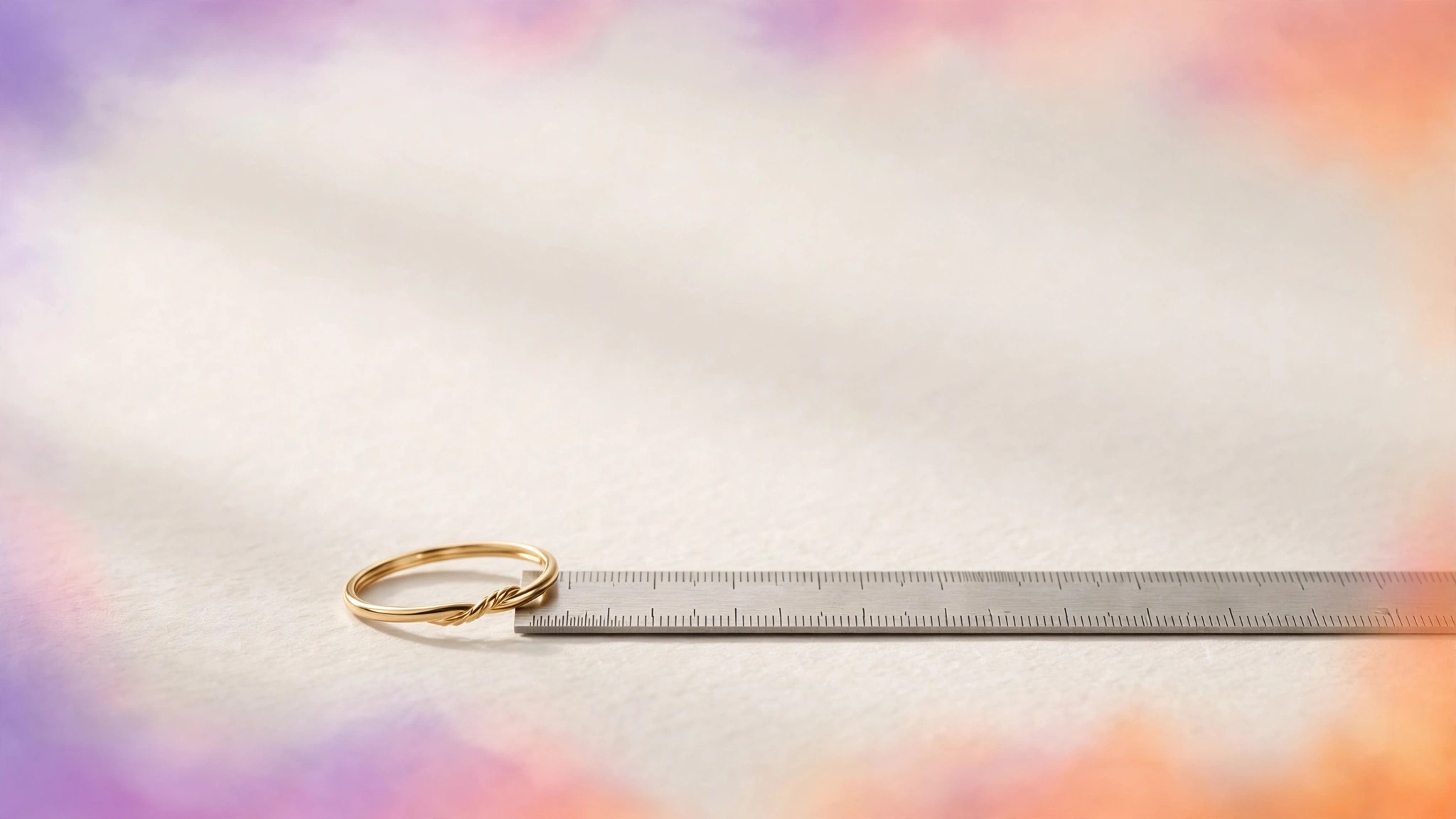
1What a ring size actually measures (start from zero)
Forget the numbers and letters for a minute. A ring size answers one physical question: how big is the hole? Slide a ring onto your finger and the only thing that matters is the inner circle — its inner diameter (straight across the inside) and its inner circumference (all the way around the inside). Every sizing system on earth is just a different way of naming that same circle.
Take the most common women's size in the US — US 6. Its inner diameter is 16.51 mm and its inner circumference is 51.86 mm. That's it. The "6" is an arbitrary label; the "L" the UK uses, the "52" the EU uses and the "14" Japan uses are all just different nicknames for a ring with a 51.86 mm inside circumference. Once you see that, converting between systems stops feeling like a mystery and starts feeling like translation.
Why does this matter in real life? Because half a size sounds tiny — and it is. The step from one half size to the next is only about 0.4 mm of inner diameter, thinner than a credit card. That's why guessing almost never works: the difference between "fits" and "spins" is smaller than most people can see with the naked eye. A tape measure, a paper strip, or our converter will beat a guess every single time.
And here's the part nobody tells you: your finger isn't a perfect cylinder. It's got a knuckle that's usually wider than the base, it swells in heat and shrinks in cold, and it changes slightly through the day. So a "size" is really a range you negotiate with your own hand — this guide will show you how to win that negotiation.
2The four systems: US, UK, EU and Japanese
Ring sizing grew up locally, long before anyone thought about a global standard. Each country's system made sense to the jewelers who invented it — and each one is now locked in by tradition.
US: plain numbers
The American system uses simple numbers from 3 to 13.5, stepping in halves. Each full size adds about 0.8 mm of inner diameter (0.8128, to be exact). The numbers themselves are arbitrary — there's no deep reason a US 6 is called "6" — but the even stepping makes the system easy to work with. Women's sizes cluster around 5–8, men's around 9–12.
UK: letters
Britain kept a much older tradition: letters from F to Z, with half-letters in between (so L½ exists too). US 3 is a UK F, US 6 is a UK L, US 9 is a UK R, and US 13 is a UK Z. It's one of the oldest sizing systems still in everyday use anywhere in the world — jewelers were sizing rings with letters before the US system existed.
EU: the honest system
Continental Europe did the most sensible thing possible: the number is the inner circumference in millimeters. An EU 52 ring measures 52 mm around the inside. No lookup needed, no tradition to memorize — the size tells you the measurement directly. This is the easiest system to work with if you measured your own finger with a paper strip, because your paper-strip number already is an EU size.
Japan: also circumference-based
Japan's system is likewise based on inner circumference, but the numbers run lower — roughly the EU number minus 38. So a US 6 (EU 52) is a JP 14, and a US 9 (EU 60) is a JP 22. If you buy from Japanese jewelers on sites like Rakuten, you'll meet this system fast.
3The math: exact conversion formulas with worked examples
You don't need to memorize formulas — our converter does the arithmetic — but seeing the math once makes the whole system click. US sizes map to inner diameter with a straight-line formula, and everything else follows from the circle.
Going the other direction is just as easy: if you measured your finger's inner diameter with calipers, subtract 11.63 and divide by 0.8128 to get the US size, then round to the nearest half.
Notice how the UK letters don't follow from math — they're a lookup table, not a formula. That's why the UK column in charts is always a reference list while the EU and JP columns are arithmetic.
4The full ring size chart (US 3–13.5)
Here it is — every half size, with its UK, EU and Japanese equivalents plus inner diameter and circumference in millimeters. Sizes vary a little between jewelers, so treat this as a strong starting point.
| US | UK | EU | JP | Diameter (mm) | Circumference (mm) |
|---|---|---|---|---|---|
| 3 | F | 44 | 6 | 14.07 | 44.20 |
| 3.5 | G | 45 | 7 | 14.47 | 45.47 |
| 4 | H | 47 | 9 | 14.88 | 46.75 |
| 4.5 | I | 48 | 10 | 15.29 | 48.03 |
| 5 | J | 49 | 11 | 15.69 | 49.30 |
| 5.5 | K | 51 | 13 | 16.10 | 50.58 |
| 6 | L | 52 | 14 | 16.51 | 51.86 |
| 6.5 | M | 53 | 15 | 16.91 | 53.13 |
| 7 | N | 54 | 16 | 17.32 | 54.41 |
| 7.5 | O | 56 | 18 | 17.73 | 55.69 |
| 8 | P | 57 | 19 | 18.13 | 56.96 |
| 8.5 | Q | 58 | 20 | 18.54 | 58.24 |
| 9 | R | 60 | 22 | 18.95 | 59.52 |
| 9.5 | S | 61 | 23 | 19.35 | 60.80 |
| 10 | T | 62 | 24 | 19.76 | 62.07 |
| 10.5 | U | 63 | 25 | 20.16 | 63.35 |
| 11 | V | 65 | 27 | 20.57 | 64.63 |
| 11.5 | W | 66 | 28 | 20.98 | 65.90 |
| 12 | X | 67 | 29 | 21.38 | 67.18 |
| 12.5 | Y | 68 | 30 | 21.79 | 68.46 |
| 13 | Z | 70 | 32 | 22.20 | 69.74 |
| 13.5 | Z+ | 71 | 33 | 22.60 | 71.01 |
If you only ever look up the popular sizes, this shortcut table covers most shoppers:
| If you wear… | US | UK | EU | JP | Inside (mm) |
|---|---|---|---|---|---|
| Petite women's | 5 | J | 49 | 11 | 15.69 across · 49.30 around |
| Common women's | 6 | L | 52 | 14 | 16.51 across · 51.86 around |
| Common women's | 7 | N | 54 | 16 | 17.32 across · 54.41 around |
| Large women's / small men's | 8 | P | 57 | 19 | 18.13 across · 56.96 around |
| Common men's | 9 | R | 60 | 22 | 18.95 across · 59.52 around |
| Common men's | 10 | T | 62 | 24 | 19.76 across · 62.07 around |
5How to measure your finger at home
You don't need a jeweler's mandrel to get a good size — a strip of paper and a ruler get you surprisingly close. Here's the method jewelers themselves recommend for at-home measuring:
- Cut a thin strip of paper about 10 mm wide and 120 mm long. Thin is better than thick — thick paper adds fake millimeters.
- Wrap it snugly around the base of the finger where the ring will sit. Snug means firm against the skin, not digging in.
- Mark where the strip overlaps with a pen, making a precise line.
- Measure the strip in millimeters from the end to your mark. That number is your inner circumference — and it's also your EU size, directly.
Timing matters more than people expect. Fingers are smallest on cold mornings and largest in warm evenings, and they swell after exercise or salty food. The reliable routine: measure in the evening, at room temperature, three times on different days. If two readings agree, that's your size. If all three scatter, take the largest — a ring that's slightly loose beats one that won't go on.
A second method works if you already own a ring that fits the same finger: measure its inner diameter with a ruler or calipers (straight across the inside, edge to edge), then run it through the converter above. Jewelers consider this the most accurate home method, because you're measuring a ring that already fits rather than a finger that changes size.
6Buying rings online: between sizes, wide bands, knuckles, surprises
Online ring shopping is where good measurements pay off, because there's no jeweler across the counter to double-check you. Four situations cover nearly every tricky purchase:
Between two sizes
If your measurement lands exactly between, say, 6 and 6.5, the standard advice is to size up. A slightly loose ring can be sized down by a jeweler cheaply; stretching a tight ring is harder, risks the setting, and sometimes isn't possible at all with certain metals like tungsten or titanium (which can't be resized, period).
Wide bands fit tighter
A band wider than about 6 mm covers more skin and squeezes more flesh than a thin band of the same inner size — it will feel roughly a half size smaller. If you're buying a wide wedding band, order a half size up from your thin-band size. Comfort-fit bands (domed on the inside) are the exception: they slide on easier and often let you keep your normal size.
The knuckle problem
For many people the knuckle is wider than the base of the finger. The ring has to pass the knuckle but live at the base — so you need a size that does both. Test any sizing by pushing the ring over the knuckle first; if it fights you there, the base fit doesn't matter. People with large knuckles and slim finger bases sometimes need a slightly larger size plus sizing beads (small metal bumps a jeweler adds inside the band) to keep the ring from spinning.
Different fingers, different sizes
Your left and right ring fingers are usually different sizes — the dominant hand runs slightly larger. Measure the actual finger the ring will live on. And note that the same nominal size can feel different in different metals: a heavy platinum band feels tighter than a light silver one at the same inner diameter, purely because of the weight.
7Common mistakes to avoid
Ring sizing goes wrong in the same handful of ways. Sidestep these and you're ahead of most buyers:
- Measuring only the base of the finger. The knuckle is the gatekeeper — the ring must pass it. Measure both spots and size for the knuckle.
- Measuring cold fingers in the morning. Fingers shrink in the cold. A morning measurement can read a half size small; by evening the ring pinches.
- Mixing up diameter and circumference. This is the big one: a "52" EU size is 52 mm around, while a 16.51 mm figure is across. They're related by π, not equal. Feeding one into the other without converting gives a nonsense size.
- Using string instead of paper. String stretches and twists, adding phantom millimeters. A non-stretchy paper strip is far more honest.
- Assuming the size transfers between fingers or hands. Left and right ring fingers differ, and an index-finger size won't match a ring-finger size. Measure the actual finger.
- Forgetting that some metals can't be resized. Tungsten, titanium and stainless steel rings generally can't be resized at all — with those, the size you order is the size you keep.
8Pro tips for a perfect fit
Jewelers' habits you can steal for free:
- Print a ruler at 100% scale — not "fit to page" — and check it against a real ruler before trusting it. Printer scaling is the silent killer of printable sizers.
- Measure three times on different days and go with the most common reading. Bodies fluctuate; one reading is a rumor, three are data.
- Between sizes? Go up — especially for wide bands over 6 mm. A jeweler can take a ring down a half size for a modest fee; going up is harder and pricier.
- Match the band width when testing. If you're sizing for a wide wedding band, test with a similar-width ring, not a thin one.
- Re-check before the wedding. If you were sized months before the big day, measure again the week before — weight, weather and stress all move fingers slightly.
Convert your size in seconds
Type your US size or inner diameter in millimeters and get the UK, EU and Japanese equivalents instantly — free, private, no signup.
💍 Open the Ring Size Converter100% free · No account · Private by design
Watch: find your fit — the ring turns and the sizes circle round.
9Frequently asked questions
How do I measure my ring size at home?
Wrap a thin strip of paper snugly around the base of your finger, mark where the ends meet, then measure the strip in millimeters. That number is your inner circumference — about 51.9 mm is a US 6. Measure in the evening, when fingers are at their largest, and do it three times on different days.
What is the most common ring size for women and men?
In the US, the most common women's ring size is 6 to 7 and the most common men's size is 9 to 10. But fingers vary a lot from person to person — measuring beats guessing every time, especially for an engagement ring.
Do ring sizes differ between countries?
Yes. The US uses numbers (3–13.5), the UK uses letters (F–Z), and the EU and Japanese systems are based on the inner circumference in millimeters — so a US 6 is a UK L, an EU 52 and a JP 14. They all describe the same physical ring, so converting is just arithmetic.
Should a ring fit tight or loose?
Snug but comfortable: it should slide over your knuckle with a little resistance and then sit on the finger without spinning freely. Your knuckle is usually wider than the base of your finger, so test the fit over the knuckle, not just the base.
Does finger size change during the day?
Yes — heat, exercise, salty food and even the time of day make fingers swell or shrink slightly. Fingers are usually smallest in the cold morning and largest in the evening. Measure in the evening at room temperature for the most reliable size.
What should I do if I'm between sizes?
Size up, especially for wide bands (over 6 mm), which fit tighter than thin ones. A slightly loose ring is easier for a jeweler to size down than a tight ring is to size up — and it's far cheaper than resizing.
Keep exploring
Ring sizes are one corner of the sizing world. These related tools cover the rest:
Related guides
More step-by-step guides on this topic: