
1What are feet and metres?
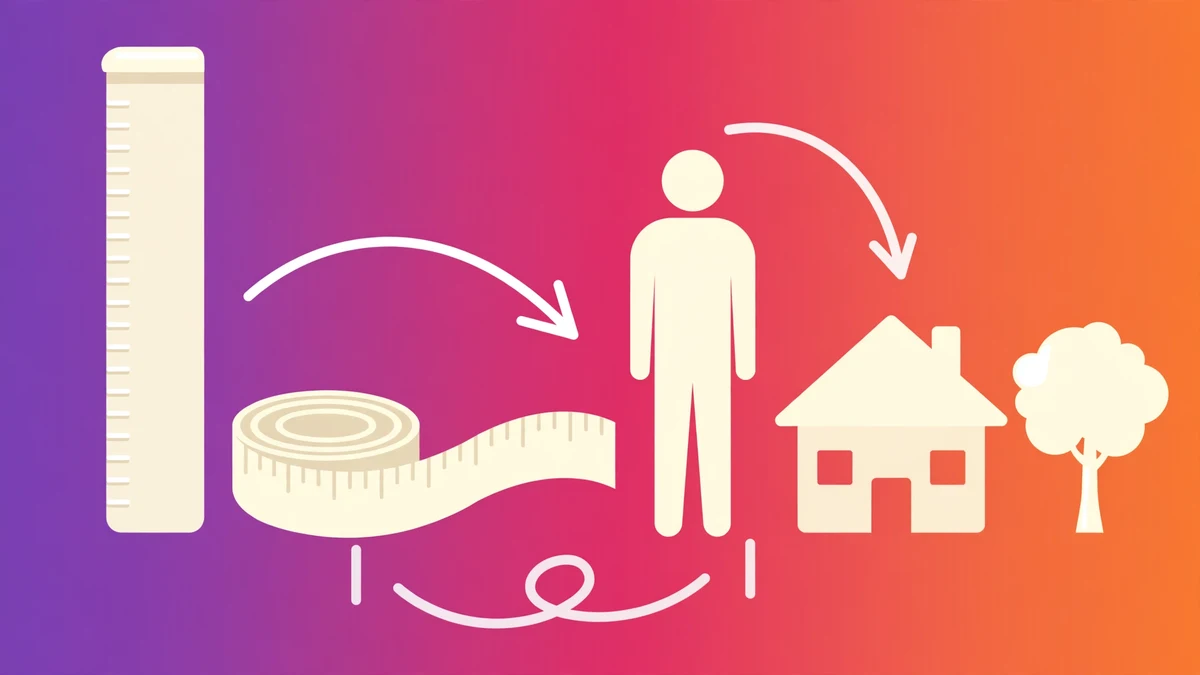
A foot is an imperial unit: 12 inches, and 3 feet make a yard. It is the everyday unit in the United States for height, rooms and construction. A metre is the metric base unit of length, used by almost every other country and all of science.
The two were formally linked in 1959, when the foot was defined as exactly 0.3048 metres. That fixed definition is what makes the conversion exact: one foot is 0.3048 metres, not approximately, but by definition.
So a 6-foot person is 1.8288 metres, a 12-foot room is 3.6576 metres, and a 100-foot building is 30.48 metres. The factor never changes, which means a converter — or a memorised multiplication — always gives the right answer.
2How to use the feet to meters converter
Three seconds:
- Type the feet — whole feet or decimals (5.5 feet works).
- Read the metres instantly.
- Flip it to convert metres back to feet.
Use it for heights on international forms, room dimensions for furniture ordered from abroad, and anything where the other side of the conversation thinks in metres.
3The formula — with worked examples
6 × 0.3048 = 1.8288 metres (usually written 1.83 m).
12 × 0.3048 = 3.6576 metres (about 3.66 m).
First convert to feet: 5 + 7/12 = 5.583 feet. Then 5.583 × 0.3048 = 1.70 metres.
Going the other way:
A handy mental shortcut: a foot is roughly a third of a metre, so divide feet by 3 for a quick estimate — 12 feet is about 4 metres (the exact answer is 3.66 m, so the shortcut overshoots a little).
4Common conversions
| Feet | Metres | What it is |
|---|---|---|
| 3 ft | 0.91 m | About a yard |
| 5 ft | 1.52 m | A short adult |
| 5 ft 7 in | 1.70 m | Average adult height |
| 6 ft | 1.83 m | A tall adult |
| 10 ft | 3.05 m | A small room |
| 12 ft | 3.66 m | A bedroom |
| 20 ft | 6.10 m | A shipping container |
| 100 ft | 30.48 m | A tall building |
Notice that 10 feet is 3.05 metres — just over 3. That is the anchor to remember: 10 feet ≈ 3 metres, and every foot after that adds about 0.3 metres.
5Mistakes people make with feet and metres
- Using 0.3 instead of 0.3048. Fine for a rough estimate, but on 100 feet it gives 30 m instead of 30.48 m — nearly half a metre short. Use the exact factor for anything that matters.
- Forgetting the inches. 5 feet 7 inches is 5.583 feet, not 5.7 feet. Convert the inches to a fraction of a foot first (7 ÷ 12 = 0.583).
- Mixing up feet and yards. 3 feet make a yard, so 12 feet is 4 yards and 3.66 metres — not 12 yards.
- Rounding too early. Round at the end. Converting 5.583 feet with a rounded factor gives a slightly wrong answer; convert exactly, then round the result.
6Metres around the world
Metres are the world's length language, and they show up in places that surprise Americans. Sports are the most visible: the 100 metres is the blue-riband Olympic event, football pitches are measured in metres, and swimming pools are 25 or 50 metres long. A marathon is 42.195 kilometres — a number that only makes sense in metric. When the Olympics report a long jump of 8.95 metres, the whole world understands it except the part that thinks in feet.
Property is the second place. Outside the US, houses are sold by square metres, rooms are measured in metres, and a flat described as "85 square metres" tells a buyer exactly what they are getting. A bedroom 3.5 metres by 4 metres is a clear, useful description; the same room in feet — 11 feet 6 inches by 13 feet 1 inch — is harder to picture and harder to remember.
Roads and signs run on metres and kilometres nearly everywhere. A sign that says "200 m" means the turn is 200 metres ahead; a speed limit of 50 means 50 kilometres per hour, not 50 miles. Visitors who think in feet and miles have to recalibrate quickly — 100 km/h is about 62 mph, and a 200-metre walk is about two minutes, not a long hike.
The trick to thinking in metres is the same as for any unit: link it to your body. Your height in metres is the anchor — 1.70 m, 1.80 m, whatever it is. A door is about 2 metres tall, a room about 3 metres wide, a car about 4.5 metres long. Once those anchors are in place, metres stop being a conversion and start being a measurement you feel directly.
7Property and rooms in metres
Outside the United States, property is sold in square metres, and the conversion from feet trips up buyers more than any other unit. A flat listed as 85 square metres is about 915 square feet — and the conversion for area is different from the conversion for length. One square metre is 10.764 square feet, so you cannot just convert the length and call it done. A room 3 metres by 4 metres is 12 square metres, which is 129 square feet.
Room dimensions are listed in metres too, and they are worth converting carefully. A bedroom described as 3.5 m by 4 m is 11 feet 6 inches by 13 feet 1 inch — a good-sized double room. A living room of 5 m by 4 m is 16 feet 5 inches by 13 feet 1 inch. And a ceiling height of 2.4 metres is 7 feet 10 inches, which is standard; a ceiling of 2.1 metres (6 feet 11 inches) feels low, and one of 3 metres (9 feet 10 inches) feels grand.
Land is the third place metres matter. A plot listed as 500 square metres is about 5,382 square feet, or 0.12 acres. A garden of 100 square metres is a decent size; a garden of 20 square metres is a balcony with ambitions. When comparing two properties, convert both to the same unit first — square metres or square feet, whichever you think in — and then compare the price per unit. A cheaper property is often just a smaller one.
One practical tip: keep a conversion in your phone for the properties you are considering. Write the length, width and area in both systems side by side, and the comparison becomes obvious. And when you visit, bring a tape measure — listings round the numbers, and a room that is listed as 4 metres wide may be 3.85 metres at the narrow end.
8Tips for thinking in metres
Learn the body anchors. Your height in metres is a number you will use for years — convert it once and remember it. 170 cm is 1.70 m; 180 cm is 1.80 m.
Think in doorways. A standard door is about 2 metres tall (6 ft 7 in). If something is taller than a door, it is over 2 metres. That mental picture is surprisingly useful.
Use the divide-by-three trick for estimates. Feet divided by 3 is roughly metres. It overshoots slightly, so subtract a little: 12 feet is about 4 metres by the trick, 3.66 exactly.
For rooms, convert both dimensions. A 12 ft by 10 ft room is 3.66 m by 3.05 m — and its area is 11.15 square metres, not 120 of anything. Convert the lengths first, then work out the area.
Convert feet to meters — try the free converter
Type any feet value and get the exact metres instantly — heights, rooms, fences, whatever you are measuring.
📏 Open the Feet to Meters Converter100% free · No account · Private by design
9Frequently asked questions
How many metres is 6 feet?
6 feet is 1.8288 metres, usually written as 1.83 m. Multiply feet by 0.3048 to get metres.
What is the formula for feet to meters?
Metres = feet × 0.3048. One foot is exactly 0.3048 metres by international definition, so the conversion is exact.
How many feet is 2 metres?
2 metres is 6.56 feet, or 6 feet 7 inches. Divide metres by 0.3048 (or multiply by 3.28084) to get feet.
Is 180 cm 6 feet?
No — 180 cm is 5 feet 11 inches. You need about 183 cm to reach 6 feet.
How do I convert 5 feet 7 inches to metres?
First turn it into decimal feet: 5 + 7/12 = 5.583 feet. Then multiply by 0.3048 to get 1.70 metres.
Why is 1 foot exactly 0.3048 metres?
The foot was standardised internationally in 1959 as exactly 0.3048 metres, linking the imperial and metric systems with a fixed, exact definition.
Keep exploring
Length comes in many units. These converters cover them all: